
Last updated September 20, 2026
Free on-site gate assessment - hinges, posts, and your LiftMaster or Nice gate operator checked before anything is quoted
The assessment is free and the quote is the invoice.

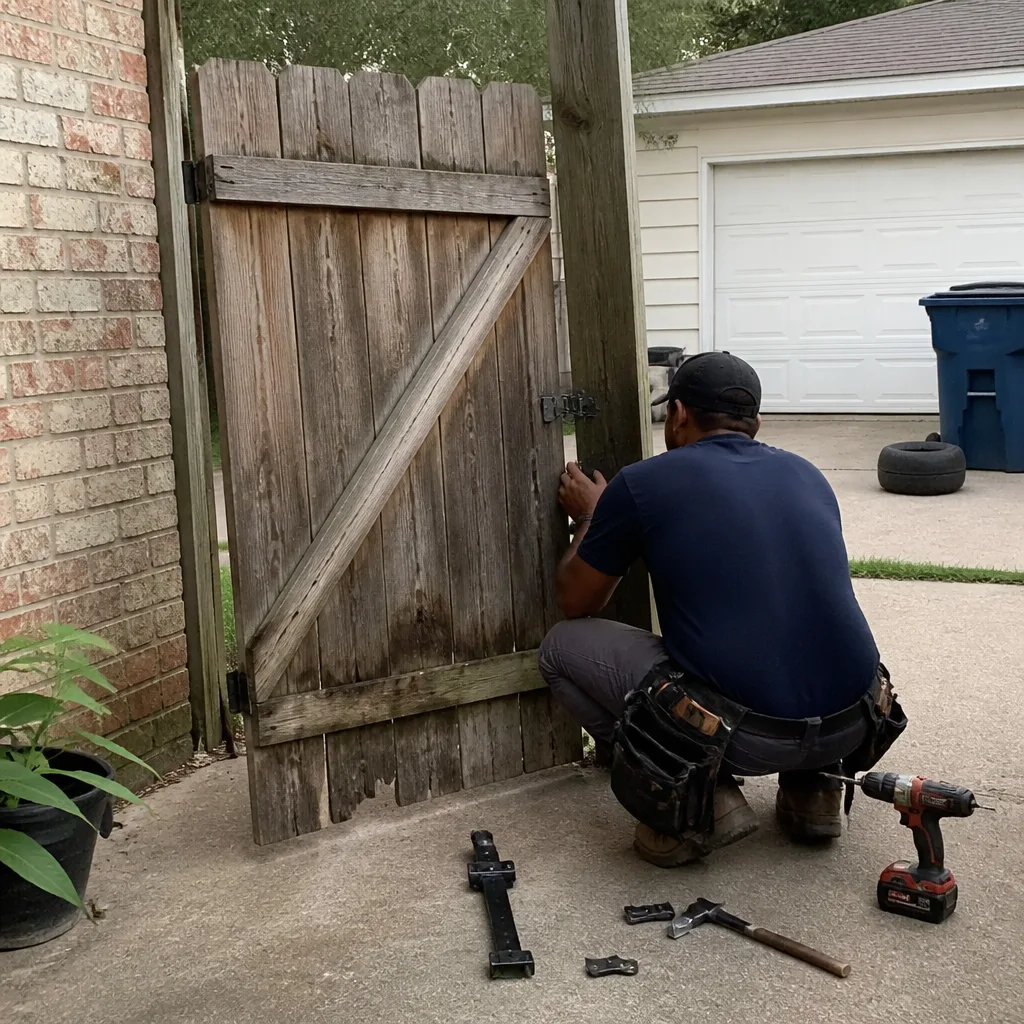 Before
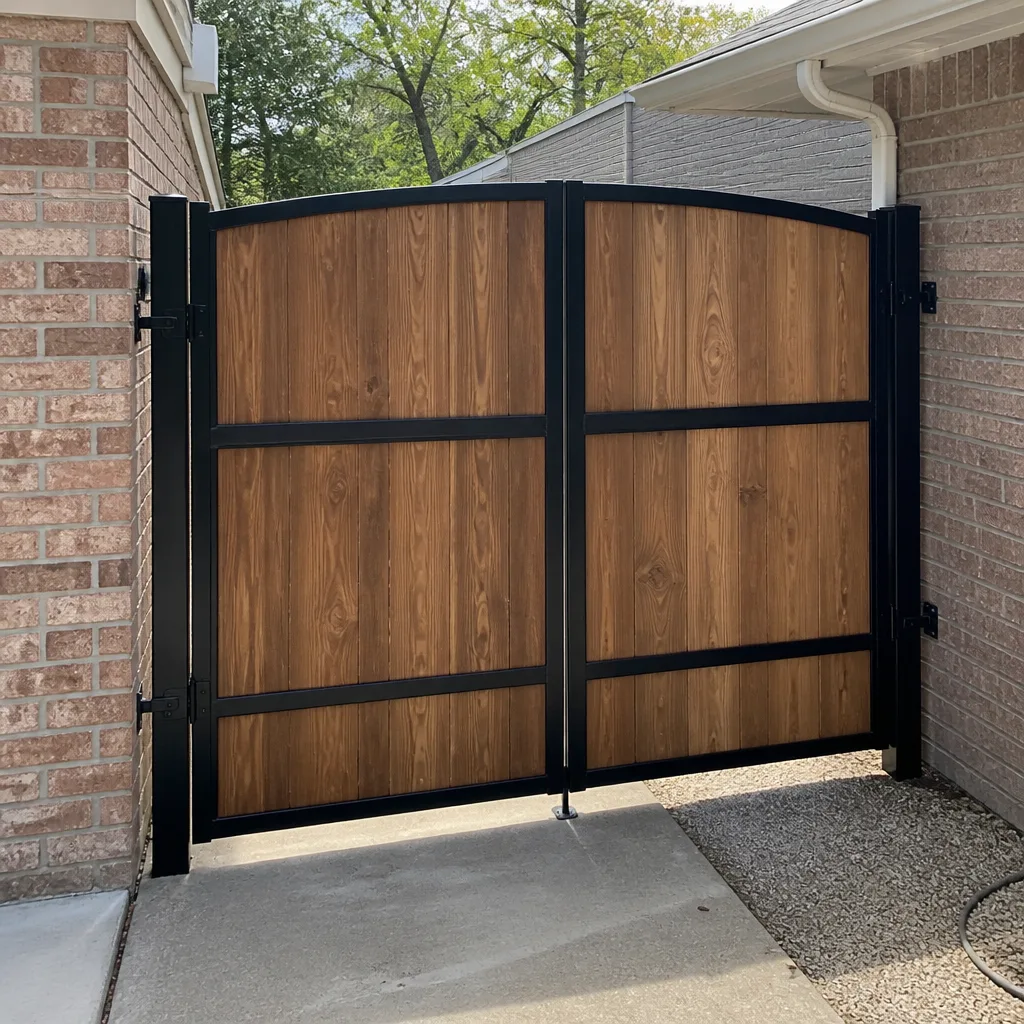 After
After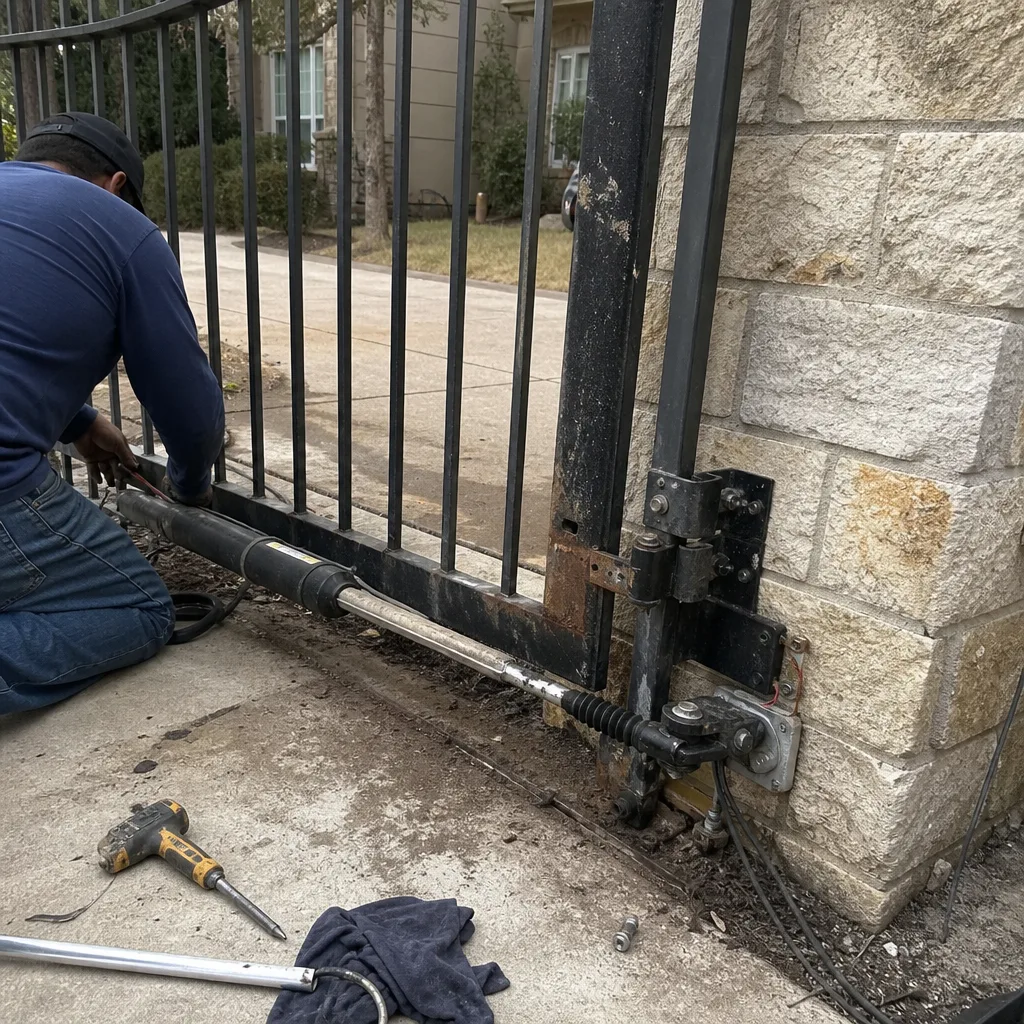 Before
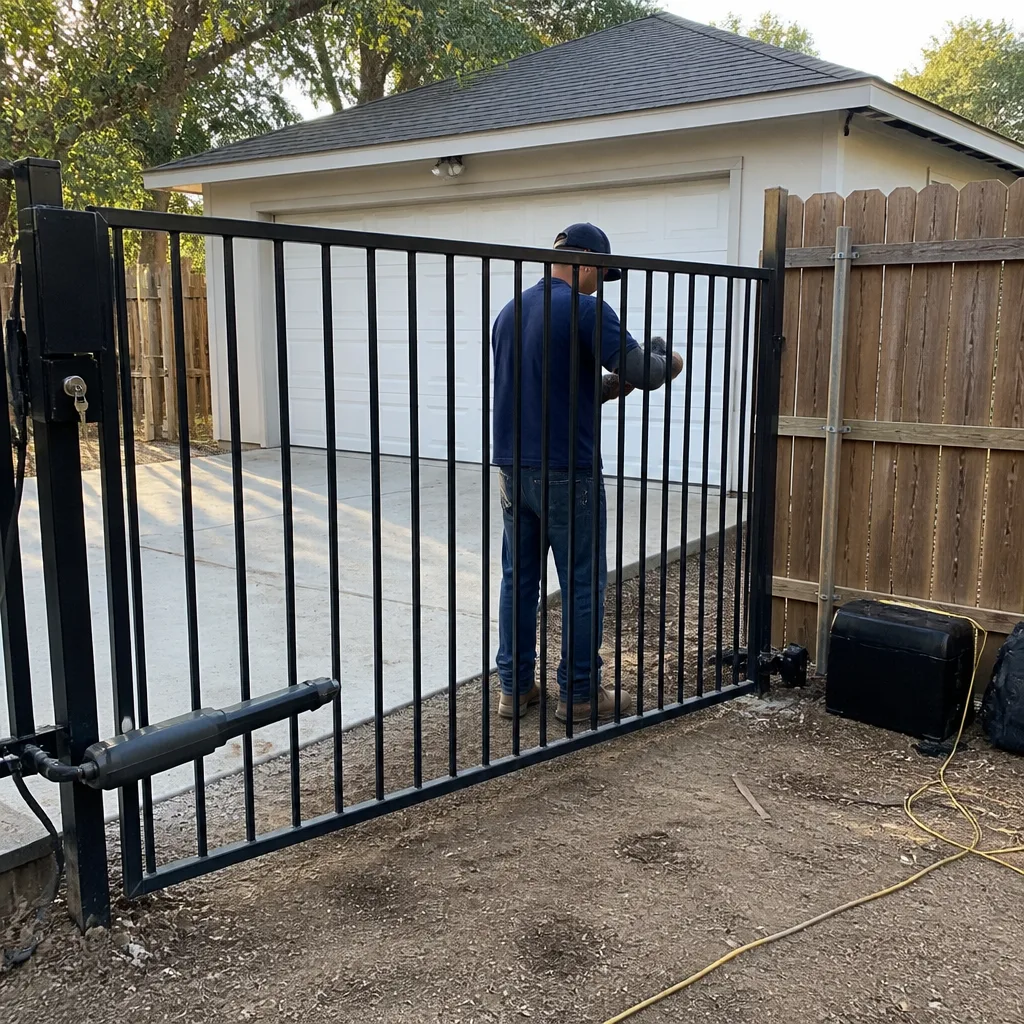 After
After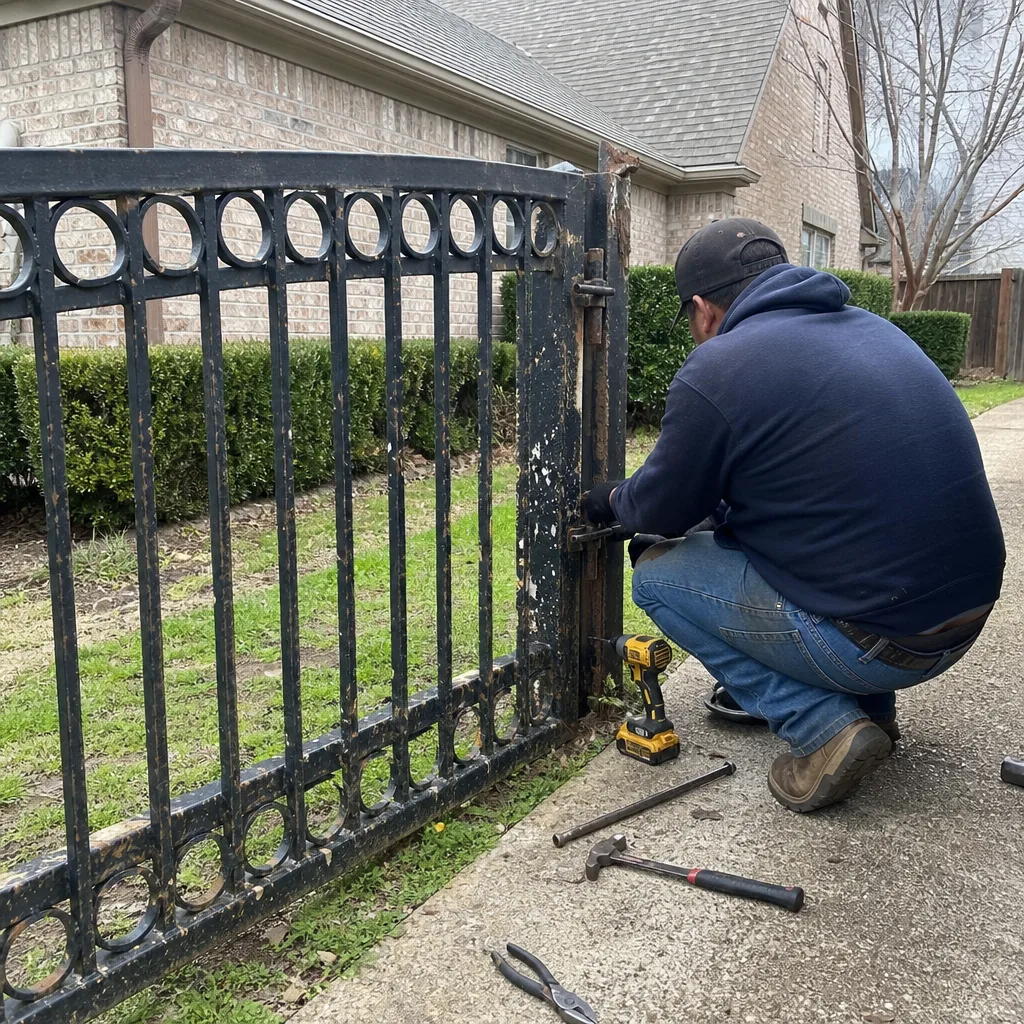 Before
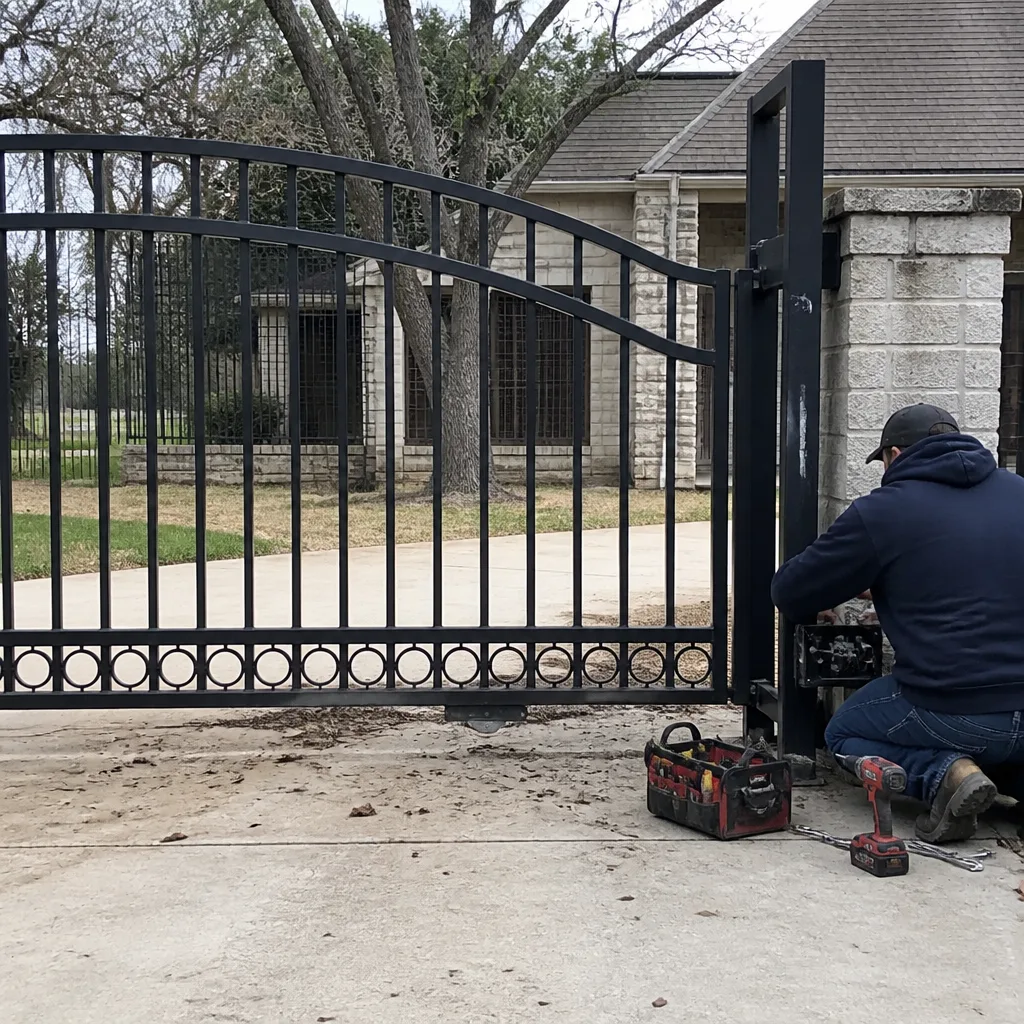 After
AfterGate Repair Warning Signs: A Mesquite Homeowner’s Reference Guide
A gate that hesitates for two seconds before moving is not “fine, just slow.” It is a motor working at elevated current draw, and that current draw is shortening the operator’s remaining life by a measurable amount every single cycle. Most Mesquite homeowners we meet don’t have a gate problem they can’t see. They have a gate problem they’ve been told is normal. This guide separates the warning signs that mean “stop using the gate today” from the ones that mean “put it on the calendar for next month,” because confusing those two categories is how a $180 limit-switch adjustment becomes a $900 operator replacement. By the end, you’ll know what each sound, pause, and rust pattern actually indicates, what it costs to fix now versus later, and which tests you can run yourself in under a minute.
Quick Answer
The most urgent gate repair warning signs in Mesquite are a gate that reverses direction on its own, a grinding sound during travel, and a safety reversal that fails to stop when blocked. Any one of those three means the gate should be taken out of automatic operation immediately and inspected by a technician. Less urgent signs like slow movement, light surface rust, or a clicking sound during opening can usually be scheduled within 30 days without risking a full failure, though the cost difference between early and late repair is often $400 or more.
Table of Contents
- The Tiered Warning System: Today, 30 Days, or Next Service
- What Your Gate Is Telling You: Sound-Specific Diagnostics
- Visual Warning Signs Specific to Mesquite Conditions
- The 60-Second Safety Reversal Test
- Warning Signs Homeowners Dismiss Because the Gate “Still Works”
- Operator-Specific Warning Signs by Brand
- Common Mistakes to Avoid
- When to Call a Professional
- Frequently Asked Questions
- The Bottom Line
BeforeAfterThe Tiered Warning System: Today, 30 Days, or Next Service
Every gate warning sign falls into one of three categories, and the category determines your response timeline. We developed this tiering after seeing too many Mesquite homeowners either ignore a serious problem for weeks or pay emergency rates for something that could have waited. The distinction is not about how alarming the symptom looks. It’s about what the symptom tells us is happening inside the operator, the hinges, or the safety circuit.
Tier 1: Stop using the gate today. These signs indicate an active safety failure or a mechanical condition that can damage the operator or injure someone within days. Take the gate out of automatic operation, switch it to manual if it has a manual release, and call a technician.
- The gate reverses direction on its own partway through travel, then closes again without input.
- The safety reversal test fails (the gate does not stop and reverse when blocked).
- You hear grinding metal-on-metal during travel.
- The gate slams at the end of travel instead of slowing down.
- The gate does not fully close, leaving a gap large enough for a child or pet to pass through.
- You smell burning from the operator housing.
A Tier 1 sign is a liability issue, not a maintenance issue. If the safety reversal is not working and a child chases a ball into the gate’s path, the gate will not stop. That’s not a hypothetical. We’ve repaired gates in Mesquite where the owner discovered the failure only after the gate struck a vehicle. The repair cost was less than the deductible, but the risk was never about money.
Tier 2: Schedule within 30 days. These signs indicate wear that will eventually cause a failure, but the gate is not currently dangerous. You have time to get a written estimate and schedule the work at normal rates. Waiting longer than 30 days, however, usually converts a Tier 2 problem into a Tier 1 emergency.
- The gate moves noticeably slower than it did a year ago, especially on hot afternoons.
- You hear a clicking sound from the control board but the gate still moves normally.
- Light surface rust is visible on the bottom rail or hinge bolts.
- The gate scrapes against the ground at one specific point in its arc.
- The remote control range has dropped by more than half.
- The operator hums for a second before the gate starts moving.
Tier 3: Note it for the next scheduled service. These are observations, not warnings. They won’t cause a failure on their own, but documenting them now gives a technician a baseline for comparison later. This is the same habit we use on commercial access-control sites: record the reading, photograph the position, and the next visit starts with data instead of guesswork.
- Paint fading or chalking on the gate frame.
- A slight squeak when the gate moves, but no other symptoms.
- Minor cosmetic rust on decorative elements that don’t touch the ground.
- Remote batteries that need changing more often than they used to.
- A gate that sits slightly out of level but still opens and closes without contact.
The tiered system only works if you act on the tier. A Tier 2 problem left for six months becomes a Tier 1 problem that costs two to three times as much to fix. Our gate repair service in Mesquite exists for exactly this reason: the earlier we see a gate, the less we have to replace.
What Your Gate Is Telling You: Sound-Specific Diagnostics
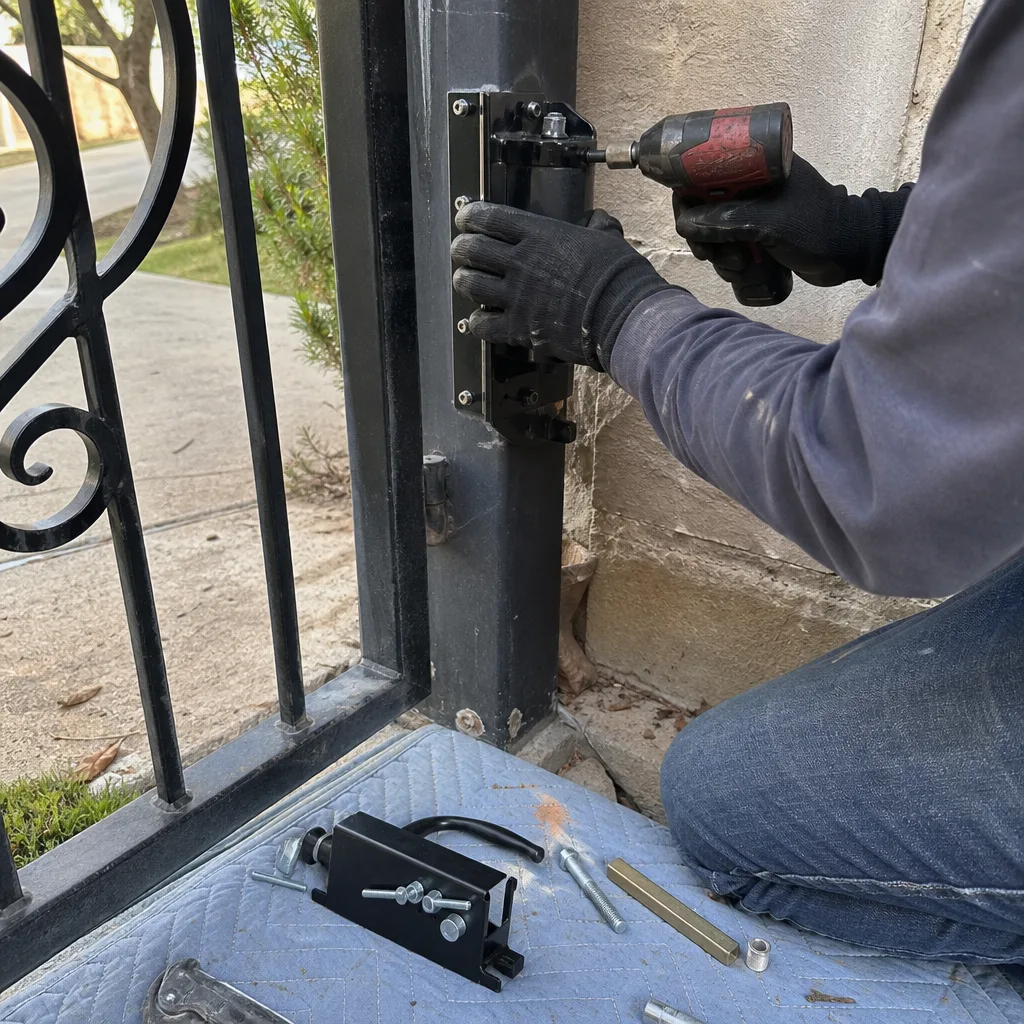
A gate in good mechanical condition is almost silent. The hum of the motor, the soft click of the limit switch, and the mechanical stop at the end of travel are the only sounds you should hear. Anything else is information. The specific sound tells us which component is failing, and the location of the sound narrows it further.
Grinding. Grinding from the operator housing means the drive gear or worm gear inside the motor assembly is wearing out. On chain-driven operators, a grinding sound along the rail usually means the chain is rubbing against the rail housing because the tension has dropped or a sprocket bearing is failing. On a swing gate, grinding at the hinge means the hinge sleeve is riding metal-on-metal, which happens when the grease has washed out, often after a particularly rainy Mesquite spring. Grinding is always Tier 1. The metal particles being produced inside the operator or hinge are also contaminating everything around them.
Clicking. A single click when you press the remote, followed by nothing, means the control board is receiving the signal but not sending power to the motor. That’s usually a relay on the board or a capacitor that’s failed. A rapid clicking sound that happens while the gate is trying to move usually means the operator is stalling against resistance - the motor is trying to turn, cannot, and the internal overload is cycling. That resistance could be a hinge binding, a wheel jammed against the track, or a bent gate frame. Clicking is usually Tier 2, but if it’s accompanied by heat from the operator, treat it as Tier 1.
Humming with no movement. A loud hum from the operator with no gate movement means the motor is receiving power but cannot turn. On swing-gate operators, this is commonly a failed capacitor or a seized gearbox. On slide gates, it’s often a jammed wheel or debris in the track. The humming itself is the motor drawing locked-rotor current, which is several times its normal operating current. That current draw overheats the windings in under 30 seconds. If you hear humming with no movement, disconnect power to the operator or use the manual release, because running it repeatedly in that condition burns out the motor. This is Tier 1.
Squealing or screeching. A high-pitched squeal during travel is usually a belt slipping on a belt-drive operator, or a metal wheel dragging against a metal track. On a swing gate, a screech at the hinge point indicates the hinge pin has worn into an oval shape and the gate is shifting under its own weight. Squealing is Tier 2 if it’s occasional, Tier 1 if it happens every cycle.
Sound diagnosis is one of the first skills we teach our technicians, because it’s the fastest way to localize a problem before dismantling anything. If you can record the sound on your phone and describe when it happens (opening, closing, halfway through travel, only in the morning), that recording saves a technician time and saves you money on the diagnostic portion of the visit.
Visual Warning Signs Specific to Mesquite Conditions
Mesquite’s climate and soil create rust patterns that a homeowner in Plano or Garland might never see. The black, expansive clay soil under most of Mesquite holds water against the bottom of a gate for days after a rain. Steel rusts, but it rusts differently depending on why it’s wet. The pattern tells us whether we’re fixing a surface or replacing a structural member.
Rust at the bottom rail, concentrated on one side. This is clay soil contact rust. The bottom rail rests close enough to the ground that the clay holds moisture against the steel for extended periods. The rust will be heavier on the side where water drains or where the gate sits slightly lower. The fix is usually mechanical: adjust the gate’s mounting so the bottom rail has proper clearance, then treat and repaint the affected area. The cause is contact with wet soil, not the steel itself failing.
Rust in the middle of the frame or at welded joints. This is water pooling rust. It happens on gates where water enters through a seam or a failed weld at the top and pools inside the frame. You’ll see rust streaking downward from the point of entry, often with a rust blister at the weld itself. The fix requires draining the tube (drilling a weep hole if one is missing), treating the inside of the tube, and rewelding any failed seams. This is structural rust and it should be addressed within 30 days if you see it.
Paint that’s bubbling or lifting at the bottom of the gate. That’s moisture trapped under the coating, and in Mesquite it’s almost always irrigation overspray. A sprinkler head that throws water onto the gate every morning is saturating the coating, and the steel underneath is rusting while it looks like a paint problem. The fix includes adjusting the sprinkler throw, not just repainting the gate.
White chalky residue on aluminum or galvanized gate parts. That’s galvanic corrosion or salt bloom. It’s less common in Mesquite than in coastal areas, but we see it on gates near pools where chlorine-treated splash water contacts the metal. The corrosion itself is usually cosmetic, but it’s a warning that water is reaching a place it shouldn’t.
A slide gate that’s beginning to lean outward at the top. In Mesquite’s clay soil, fence posts and gate posts move with the moisture cycle. A slide gate that leans outward means its support post is moving, and the gate’s center of gravity is now outside the track. The leaning will get worse with each wet-dry cycle, and the gate will eventually jump the track or bend the track rail. This is a Mesquite-specific failure mode, and it’s one of the first things we look for on any slide gate service call.
The 60-Second Safety Reversal Test
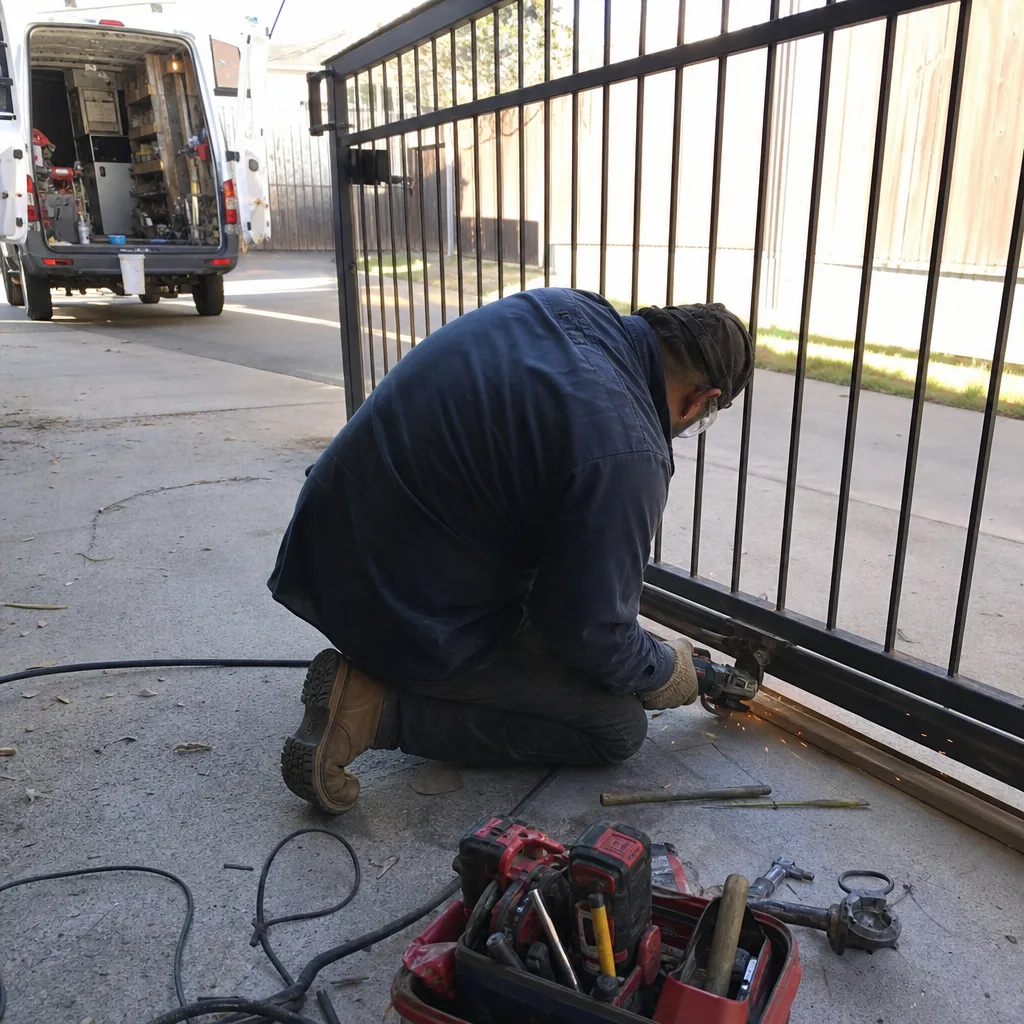
Your gate has a safety system built into it that’s designed to stop and reverse the gate if something is in the path. That system has one job: to prevent the gate from closing on a person, a pet, or a vehicle. It is not optional equipment. On every operator we service, including Linear, Viking, Ghost Controls, and DoorKing units, the safety reversal function is tested before we leave. Here’s how to test it yourself.
- Open the gate fully using the remote or keypad.
- Press the close button and stand clear of the gate’s path.
- When the gate is about halfway through its closing travel, place a rigid object (a 2×4 standing on end, or a metal trash can) in the gate’s path. Do not use your hand or body as the test object.
- Watch what happens. The gate should detect the obstruction and immediately stop and reverse direction.
- If the gate stops but does not reverse, the reversal force setting is too high or the sensor is failed. This is a failing test.
- If the gate pushes through the obstruction, the safety system is not functioning. Stop using the gate in automatic mode immediately.
A gate that fails this test is a liability problem, not a mechanical annoyance. If the gate will not reverse on contact, it will also not reverse on a child, a dog, or a car parked halfway through the opening. This test takes under a minute and it’s the single most important thing you can do to know whether your gate is safe to operate. In our experience, about one in five Mesquite gates we’re called to repair has a safety reversal that’s out of adjustment, and the homeowner had no idea because the gate opened and closed fine every day.
Warning Signs Homeowners Dismiss Because the Gate “Still Works”
The most expensive repairs we perform are almost never the result of a sudden, unpredictable failure. They’re the result of a warning sign that was visible for months and dismissed because the gate still opened and closed. Here are the signs we see dismissed most often, and the cost difference between catching them early and catching them late.
Slow travel time. A swing gate that took 12 seconds to open and now takes 18 seconds is working harder. The most common cause is a failing capacitor on the operator, but it can also be a hinge binding as the grease dries out or a control board that’s operating the motor at reduced voltage. Early fix: replacing a capacitor, typically $120 to $190 installed. Late fix: replacing an operator that overheated and burned out its motor windings, typically $650 to $1,100 depending on brand and model.
A gap at the closed position that wasn’t there before. The gate used to close tight against the post. Now there’s a two-inch gap. That’s usually a limit switch that’s drifted out of adjustment or a hinge that’s worn enough to shift the gate’s resting position. Early fix: limit switch adjustment or hinge bushing replacement, $90 to $180. Late fix: a bent gate frame from the gate’s weight hanging on a worn hinge, $400 to $800 in welding and realignment.
Remote range that’s dropped by half. You now have to be in the driveway for the remote to work, where it used to open the gate from half a block away. Early fix: a new receiver or antenna relocation, $80 to $150. Late fix: the same repair, but performed after you’ve paid an emergency fee because the gate stopped responding entirely and you couldn’t get your car out. The repair is the same; the timing changes the price.
A humming sound that lasts for two seconds before the gate moves. That two-second delay is the motor drawing more current than it should while it overcomes resistance. Early fix: lubricate or replace the hinge bushings and adjust the gate’s alignment, $100 to $250. Late fix: a burned-out operator motor, $650 to $1,100.
The pattern is consistent. Every one of these signs is a $100 to $250 repair if addressed within 30 days. Every one becomes a $600 to $1,100 repair if ignored for a season. The gate still “working” is not the same as the gate working correctly. We’ve written this guide because the distinction matters, and because most Vance Gate Repair Mesquite home service calls start with a homeowner who wishes they’d known the difference six months earlier.
Operator-Specific Warning Signs by Brand
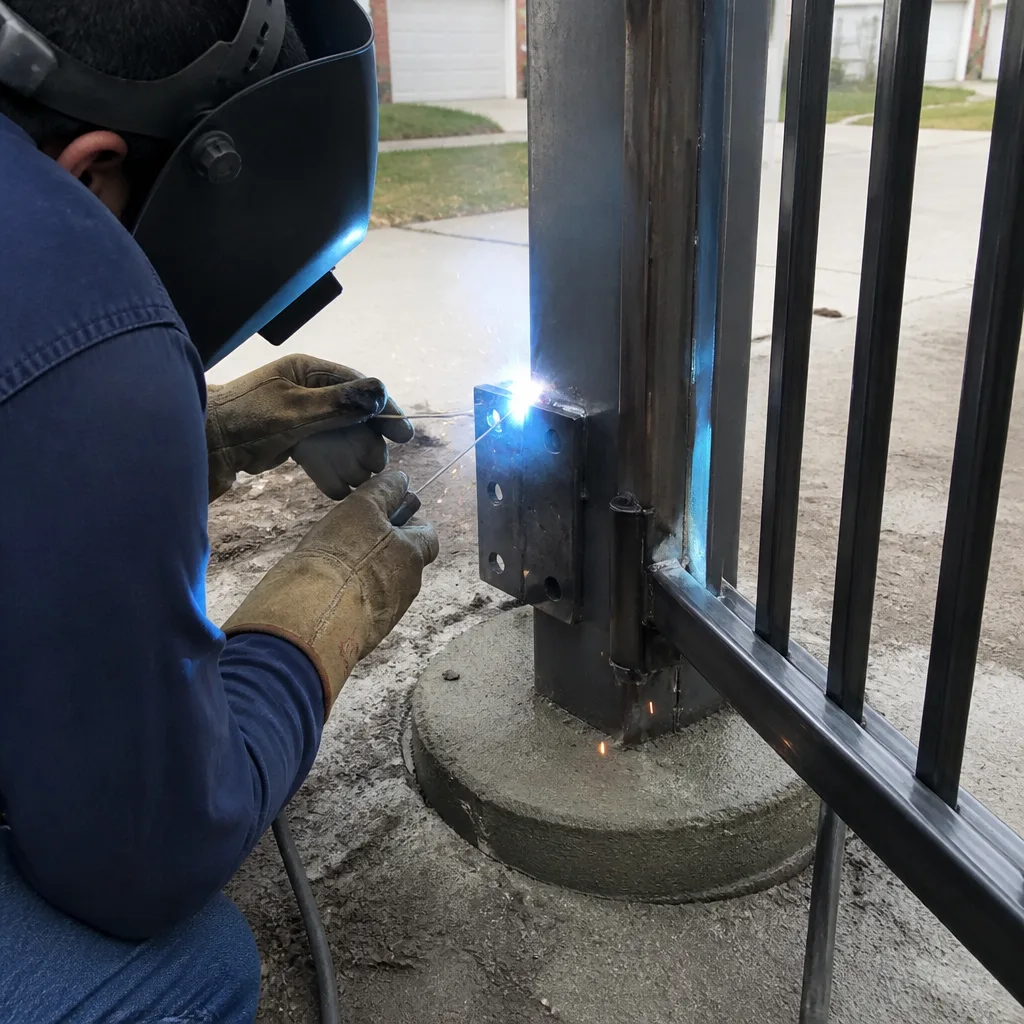
Different operator brands fail in different ways, and knowing which brand is on your gate can help you interpret the warning sign correctly. We service all nine major automation brands, but three of them have failure modes worth mentioning specifically because we see them regularly on Mesquite properties.
Linear operators (common on older Mesquite swing gates) have a known weak point in the limit-switch assembly. The switch itself is a mechanical cam that can drift out of position over time, especially on gates that cycle more than 20 times a day. The warning sign is a gate that stops short of the close position by a few inches, or one that slams harder than it used to at the end of travel. Both symptoms mean the limit switch is no longer triggering at the correct position. The fix is a mechanical adjustment, and it’s one of the more common repairs we perform on Linear units.
Viking operators are built for commercial duty cycles, but their residential units share the same control-board architecture, and the board’s relay contacts can wear after years of daily cycling. The warning sign is a gate that sometimes fails to respond to the remote on the first press, but works on the second. That intermittent failure usually means the relay is starting to stick. Early fix: relay replacement or board-level repair, $150 to $300. Late fix: a board that fails entirely, $400 to $600.
Ghost Controls operators are popular on DIY-installed gates, and we see a specific pattern with them: the gate works fine for years, then starts reversing unexpectedly partway through travel. That’s usually the force-sensitivity setting drifting or a photo-eye that’s losing alignment. The warning sign is a gate that reverses for no visible reason, but only at certain times of day (often when the sun hits the photo-eye at a low angle and blinds the sensor). The fix is realigning the photo-eye or adjusting the force setting, and it usually takes under an hour.
One more note that applies to all brands: if your operator was installed by a company that has since gone out of business or stopped answering calls, you are not locked into that company for service. We repair operators regardless of who installed them, and we leave you with a written record of every setting we changed so a future technician (or you, if you’re mechanically inclined enough to compare numbers) has a baseline. That documentation habit is part of how we’ve always worked, dating back to our commercial access-control days.
Common Mistakes to Avoid
- Replacing the remote batteries before checking whether the operator is the problem. A gate that doesn’t respond can be a dead remote, a failed receiver, a tripped breaker, or a burned-out motor. Replacing the batteries is a fine first step, but if the gate still doesn’t respond, don’t keep troubleshooting. Each attempt to run a stalled motor adds heat damage.
- Lubricating a hinge that’s already worn out. Grease is not a substitute for a bushing that’s worn through. Applying grease to a metal-on-metal hinge makes it quieter for a few days, then the problem returns worse because the grease attracted dust. If a hinge squeaks, inspect the bushing; if it’s worn, replacing it is the fix.
- Powering through a gate that’s binding. If the gate is hard to push manually, the operator is also struggling, even if it “gets there eventually.” The extra current draw is shortening the motor’s life every time. Find the binding source and fix it before the motor becomes the casualty.
- Ignoring a safety reversal failure because “we don’t have kids.” The gate doesn’t only need to protect children. It also needs to protect your vehicle, your delivery drivers, your landscaping crew, and you. A gate that won’t reverse on contact is a liability on the property, not a personal preference.
- Waiting until the gate fails completely before calling. Emergency calls cost more, and a gate that fails at 10 PM on a Sunday leaves your driveway open all night or trapped in the garage. The tiered system above exists precisely because a planned repair at normal rates is always cheaper than a dispatch call at midnight.
- Assuming the installer’s original settings are still correct years later. Limit switches drift, photo-eyes get bumped, force settings need adjustment as hinges wear. Settings that were correct on installation day are not necessarily correct after five Mesquite summers of expansion and contraction.
- Repainting a rusted gate without addressing the water source. Paint over active rust lasts a few months. The rust continues under the coating, and the structural steel keeps thinning. Find the water, fix the drainage or the sprinkler, then treat and paint.
When to Call a Professional
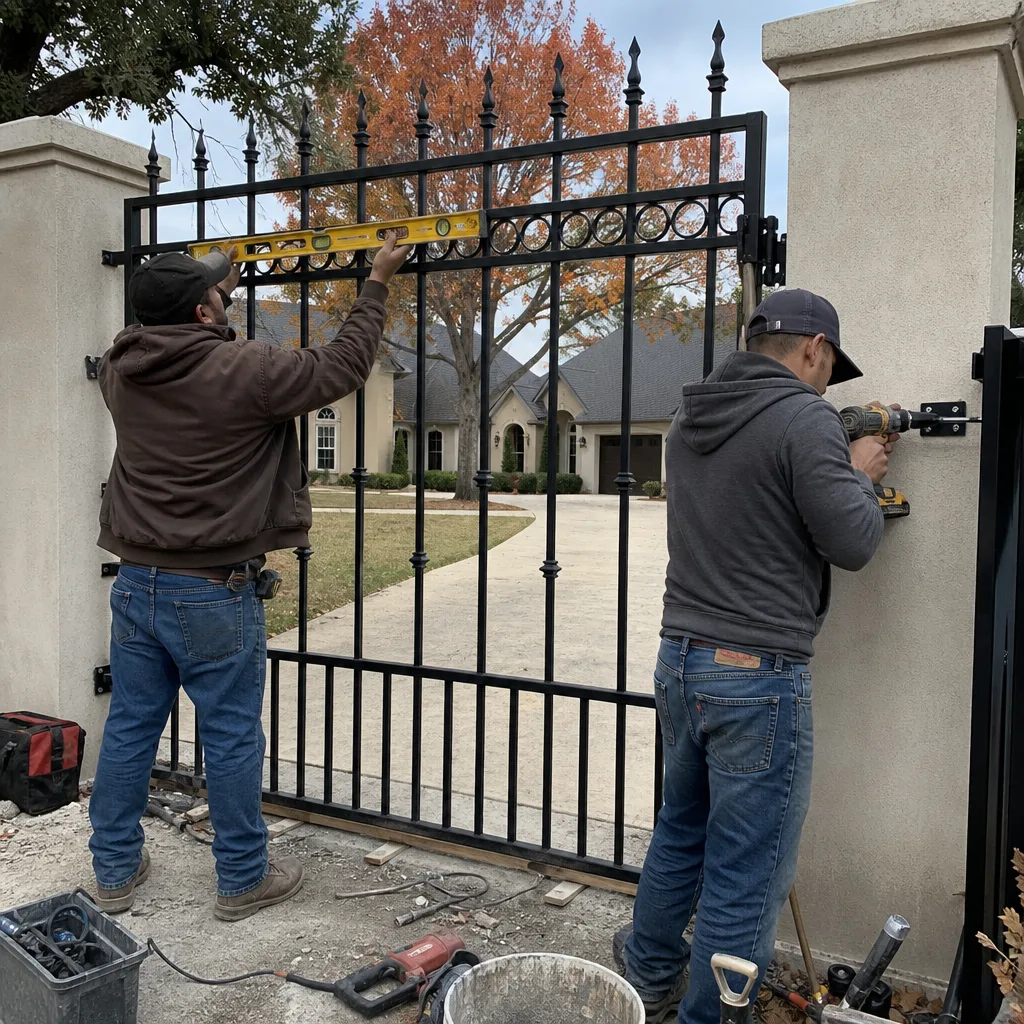
Some gate problems are safe to observe and document for a few weeks. Others require a technician’s diagnostic equipment and training. Call a professional if your gate fails the safety reversal test, if it reverses on its own during travel, if you hear grinding from the operator housing, or if you smell burning from the motor. Those are not observation situations. They are stop-using-the-gate situations, and the problem will not resolve itself.
You should also call if you’ve noticed a combination of Tier 2 signs that’s lasted longer than a month, if the gate has been hit by a vehicle (even a slow bump can bend a hinge ear or shift the mounting post), or if you’ve recently had landscaping work done near the gate path and the gate now behaves differently. Sprinkler strikes, edging tools against the post, and shifted soil all change how a gate sits and moves.
We offer free estimates on all gate repair work in Mesquite. If you’ve got a gate that’s showing one of the signs in this guide and you’re not sure which tier you’re in, call us at (469) 916-7097. We’ll ask a few questions, help you determine whether it’s a today problem or a this-month problem, and give you a written price before any work starts. That’s how we’ve handled every gate motor and opener service in Mesquite since 2014, and it’s not negotiable on our end.
Frequently Asked Questions
Most gate repairs in Mesquite fall between $120 and $450, depending on what’s failed. Limit switch adjustments and photo-eye realignments run $90 to $180. Capacitor replacements run $120 to $190. Hinge bushing replacements run $100 to $250 per hinge. Full operator replacements run $650 to $1,100 depending on brand and whether the existing mounting bracket can be reused. Every price is quoted in writing before work starts, so there’s no surprise invoice at the end.
For Tier 1 emergencies like a gate that won’t close or a safety reversal that’s failing, our dispatch can usually route a technician to your Mesquite property the same day. A live person answers the phone at (469) 916-7097 at any hour, and we’ll tell you whether same-day service is available before we ask for any commitments.
A full service call includes a diagnostic pass on the entire gate system: hinges, operator, control board, safety sensors, limit switches, remote receivers, and the physical gate frame. The technician photographs what was found, makes the repair, photographs what was changed, and leaves you with a written record of every adjustment and every part installed. You’ll know exactly what was done and what the settings are, in case you ever need to compare them later.
Yes. If your gate needs a new power run from the house, repairs to the safety edges or photo-eyes, or a full safety-system upgrade, that’s all handled as part of our gate installation service in Mesquite. The safety edges and photo-eyes are not optional add-ons; they’re part of any code-compliant automated gate, and we treat them as part of the core job, not as an upsell.
Yes, and it points to a specific problem. Cold-weather grinding usually means the lubricant inside the operator’s gearbox has thickened or dried out, and the gears are running with inadequate lubrication. The cold makes it audible, but the wear is happening year-round. It’s a Tier 2 sign that should be scheduled within 30 days, because the same gears are wearing during Mesquite’s summer heat too, you just can’t hear it over the ambient noise.
You can, and it’s often a workable project for a mechanically inclined homeowner. The common failure point is not the mechanical mounting; it’s the wiring and safety-system integration. The operator needs to be properly matched to the gate’s weight and length of travel, the safety reversal force needs to be set correctly, and the photo-eyes need to be wired in series with the controller. If any of those is set wrong, the gate will work and still be unsafe. If you’ve already got an operator that just needs adjustment or repair, we’ll repair it rather than pushing a replacement. That’s the whole point of servicing nine brands instead of one.
Call (469) 916-7097 for an exact quote on any gate repair in Mesquite. Estimates are free, and the price you’re quoted is the price you’ll pay.
The Bottom Line

Your gate talks to you every time it opens and closes. The hesitation, the hum, the grind, the rust pattern at the bottom rail, the gap at the closed position: each one is a specific piece of information about what’s wearing, what’s binding, and what’s about to fail. The tiered system in this guide exists so you can sort those signals into three piles: act today, schedule this month, or note it for later. Acting on a Tier 2 sign within 30 days typically saves $400 to $900 compared to waiting for a full failure. The safety reversal test takes under a minute and tells you whether your gate is actually safe. And when you do call a technician, get the price in writing before work starts. That’s not a negotiation tactic; it’s the difference between a repair and a surprise.
Written by Adrian Vance, Owner at Vance Gate Repair Mesquite, serving Mesquite since 2014.