
Last updated September 20, 2026
Free on-site gate assessment - hinges, posts, and your LiftMaster or Nice gate operator checked before anything is quoted
The assessment is free and the quote is the invoice.



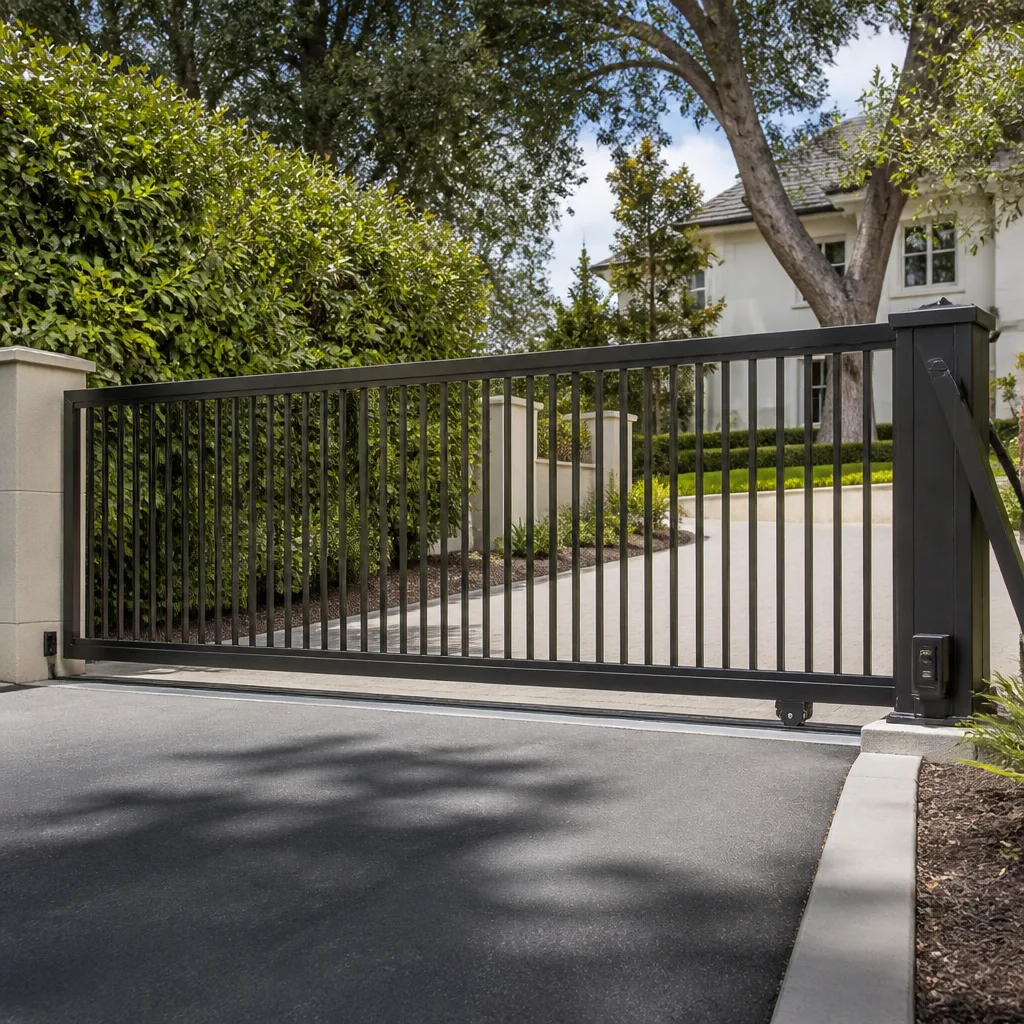
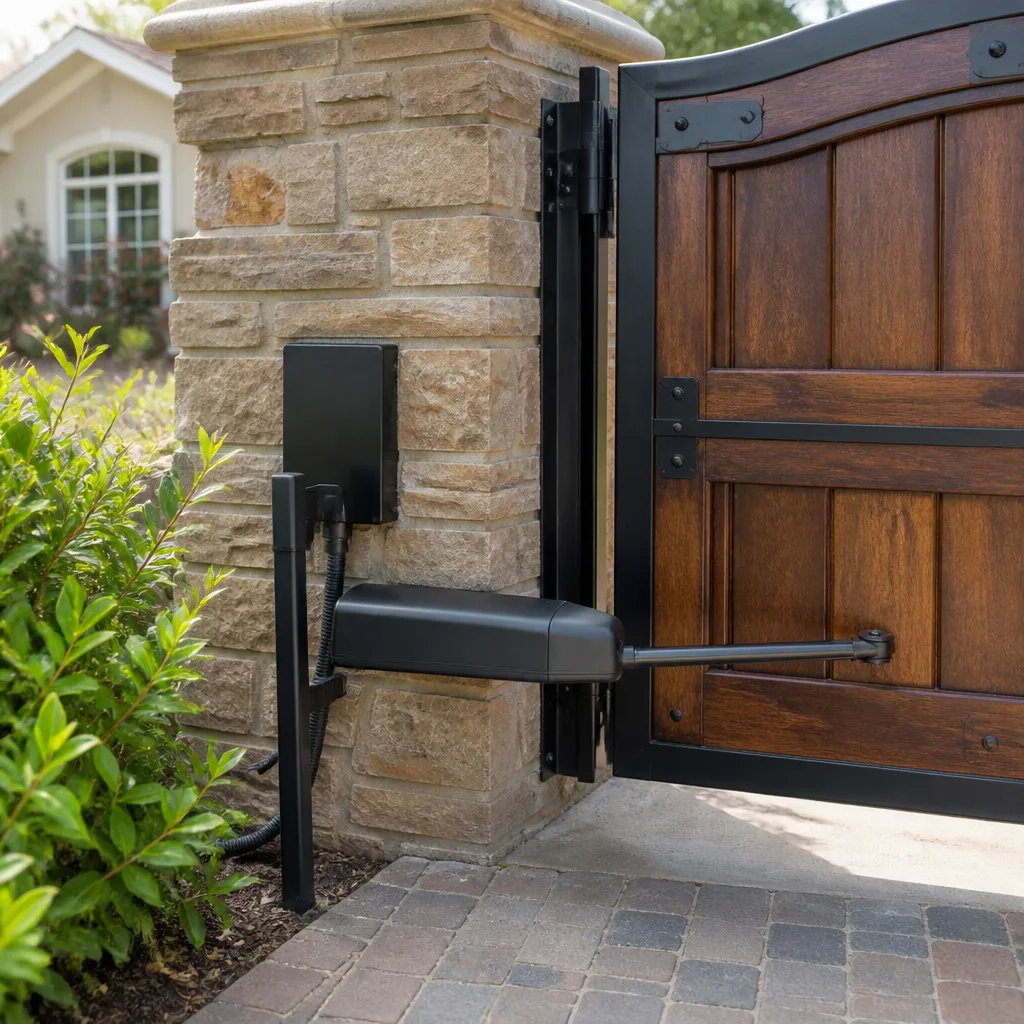
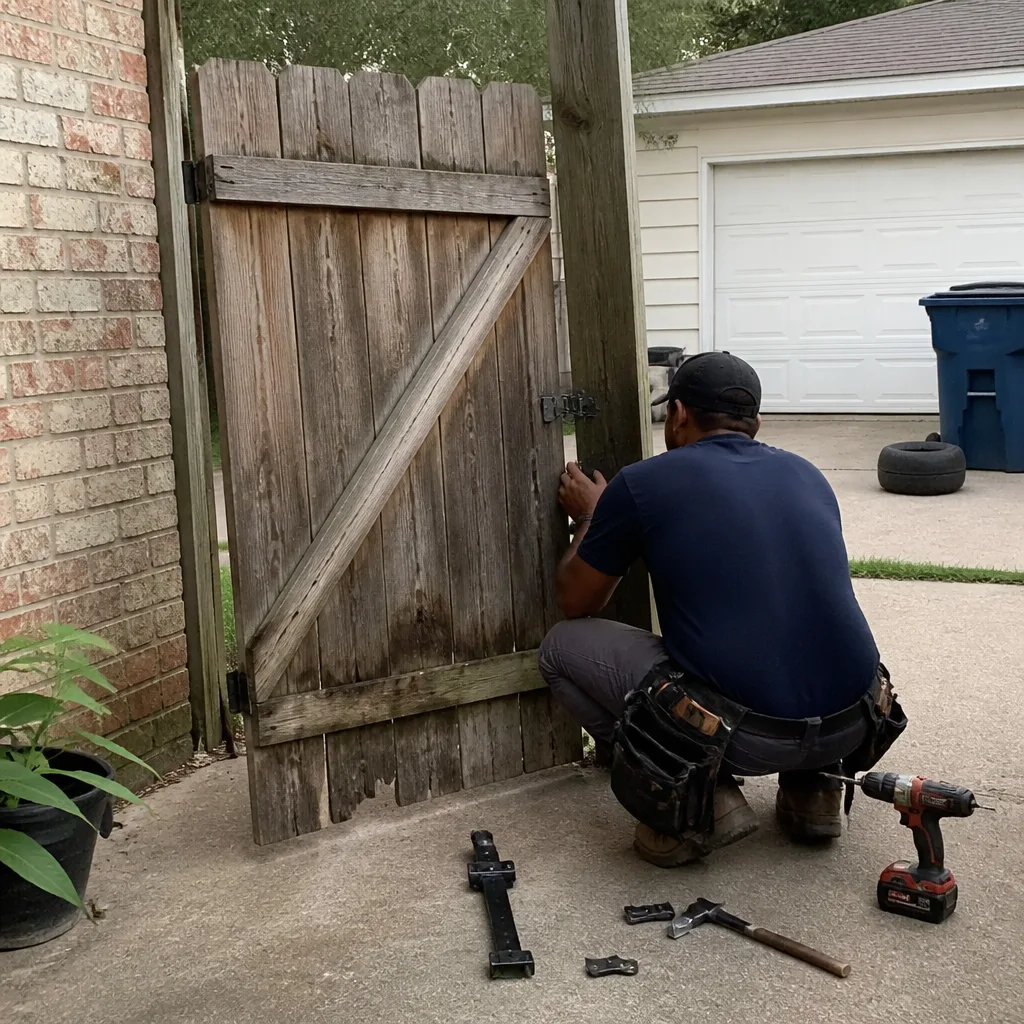 Before
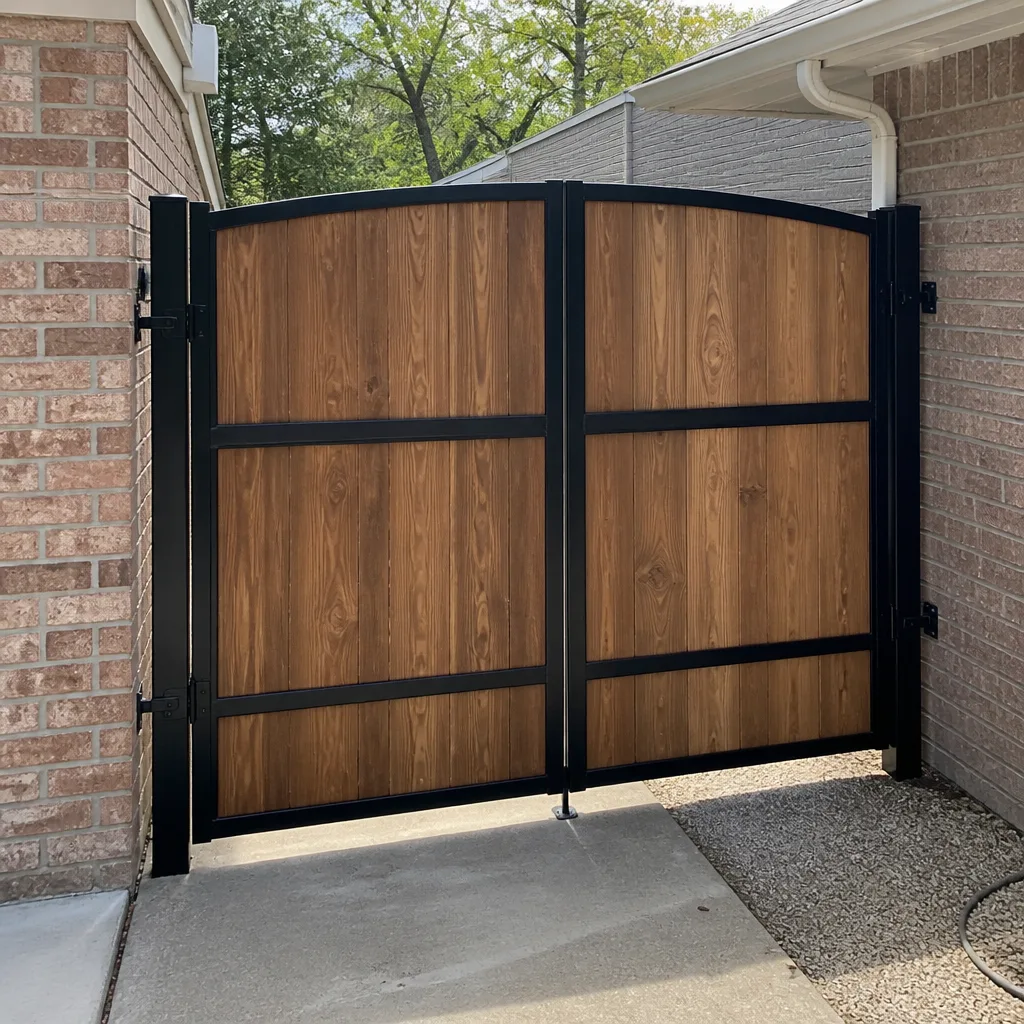 After
After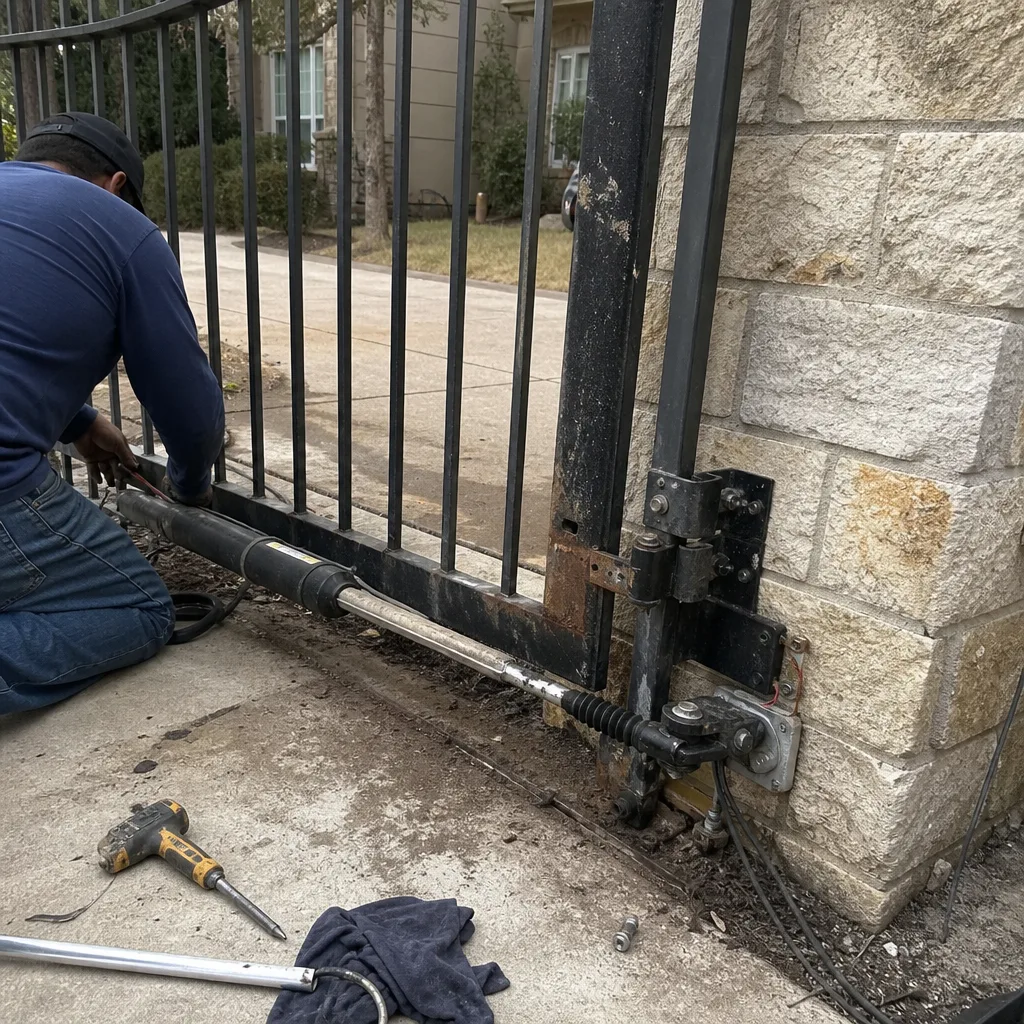 Before
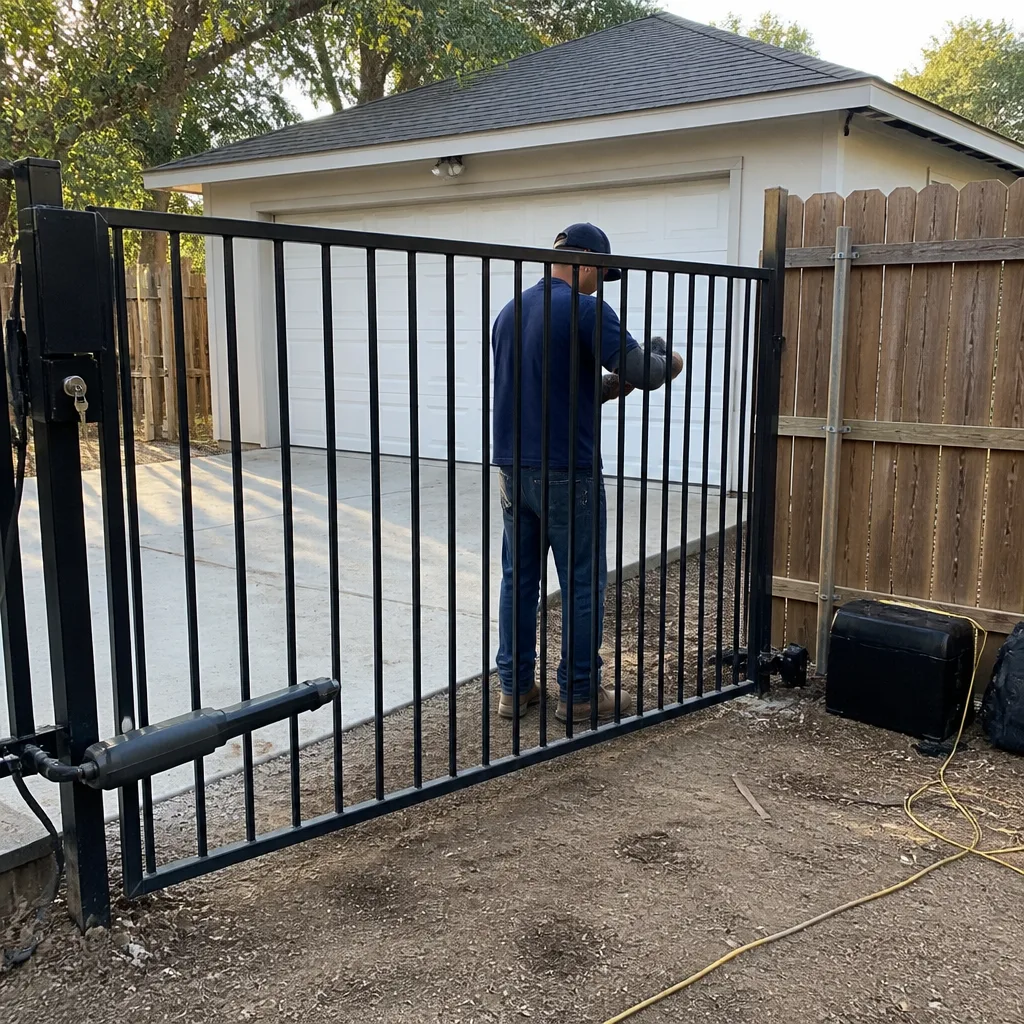 After
After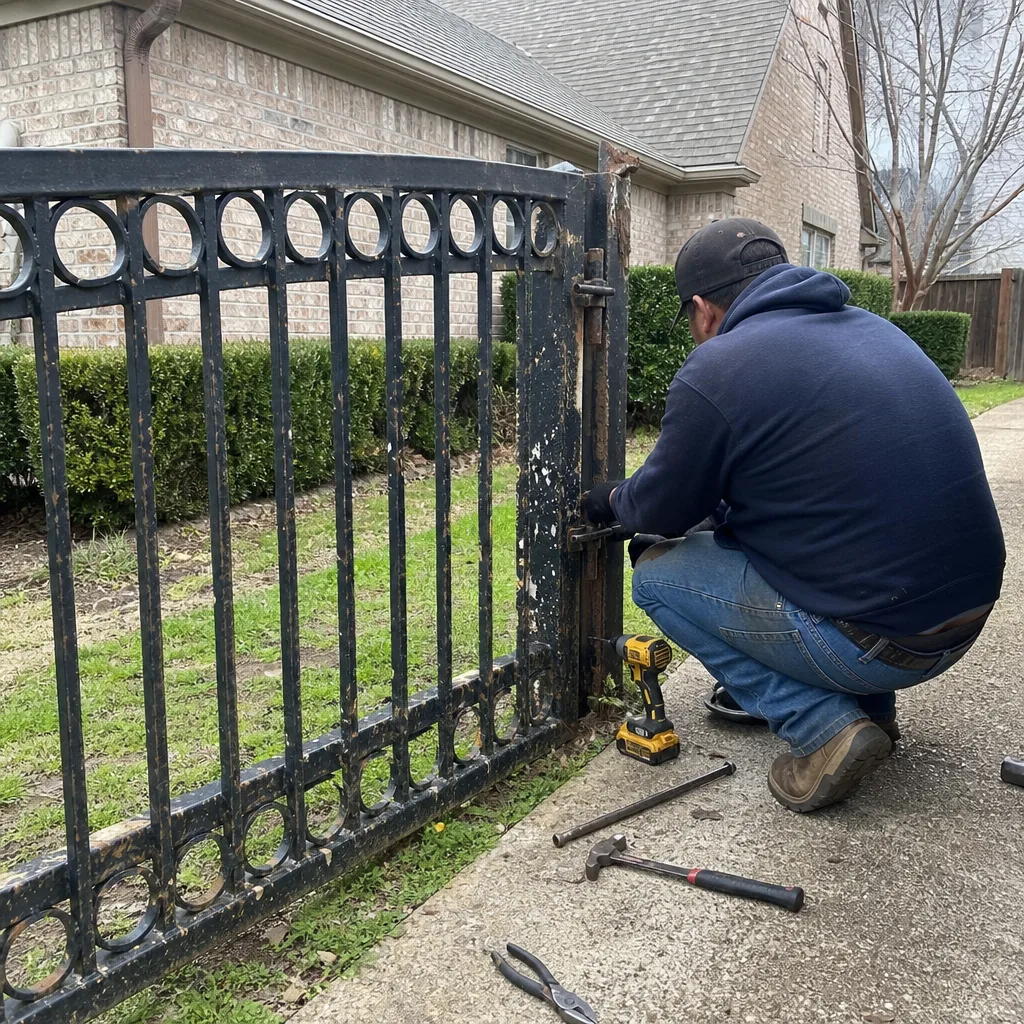 Before
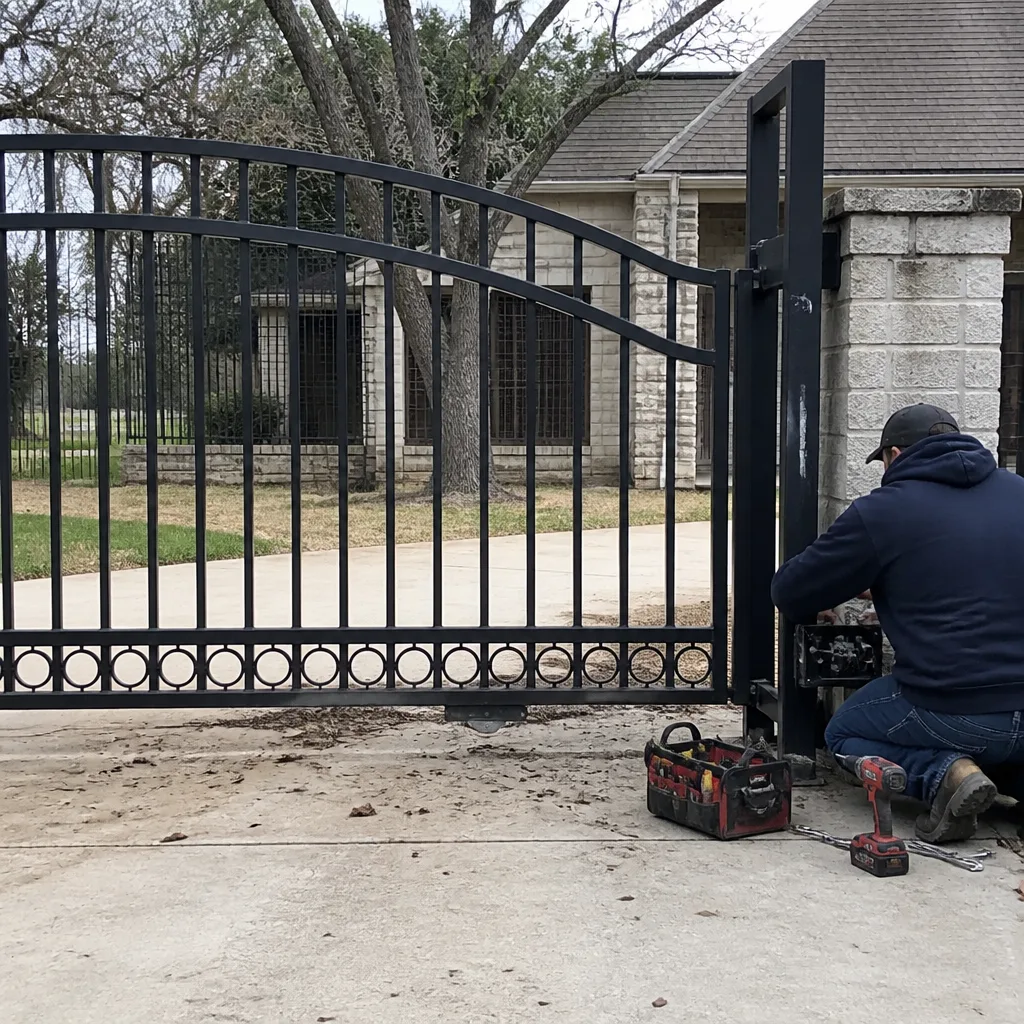 After
AfterSeasonal Gate Repair Care for Mesquite: Year-Round Homeowner’s Guide
Most gate operator failures in Mesquite don’t happen randomly. They cluster in two predictable windows: August, when sustained triple-digit heat cooks circuit boards and thins out grease until metal grinds on metal, and the week after the first hard freeze, when moisture that seeped into concrete post footings expands overnight and shifts the geometry of the entire gate. Neither failure is mysterious. Both are the direct result of skipping two service windows that open and close on a calendar most Mesquite homeowners can set their watch to. This guide walks through exactly what happens to your gate during each season, what to do about it, and when those jobs need to happen so you’re not standing in a driveway at 6 a.m. with a gate that won’t open. For a deeper dive, see The Complete Guide to Gate Repair in Mesquite.
Quick Answer
Seasonal gate care in Mesquite means servicing your gate twice a year: once in March or April before summer heat arrives, and once in October or November before the first freeze. The pre-summer service focuses on electronics, grease, and limit-switch calibration, while the pre-winter service focuses on post footings, lubrication spec, and operator battery health. Each service window takes under two hours and costs far less than the repairs it prevents.
Table of Contents
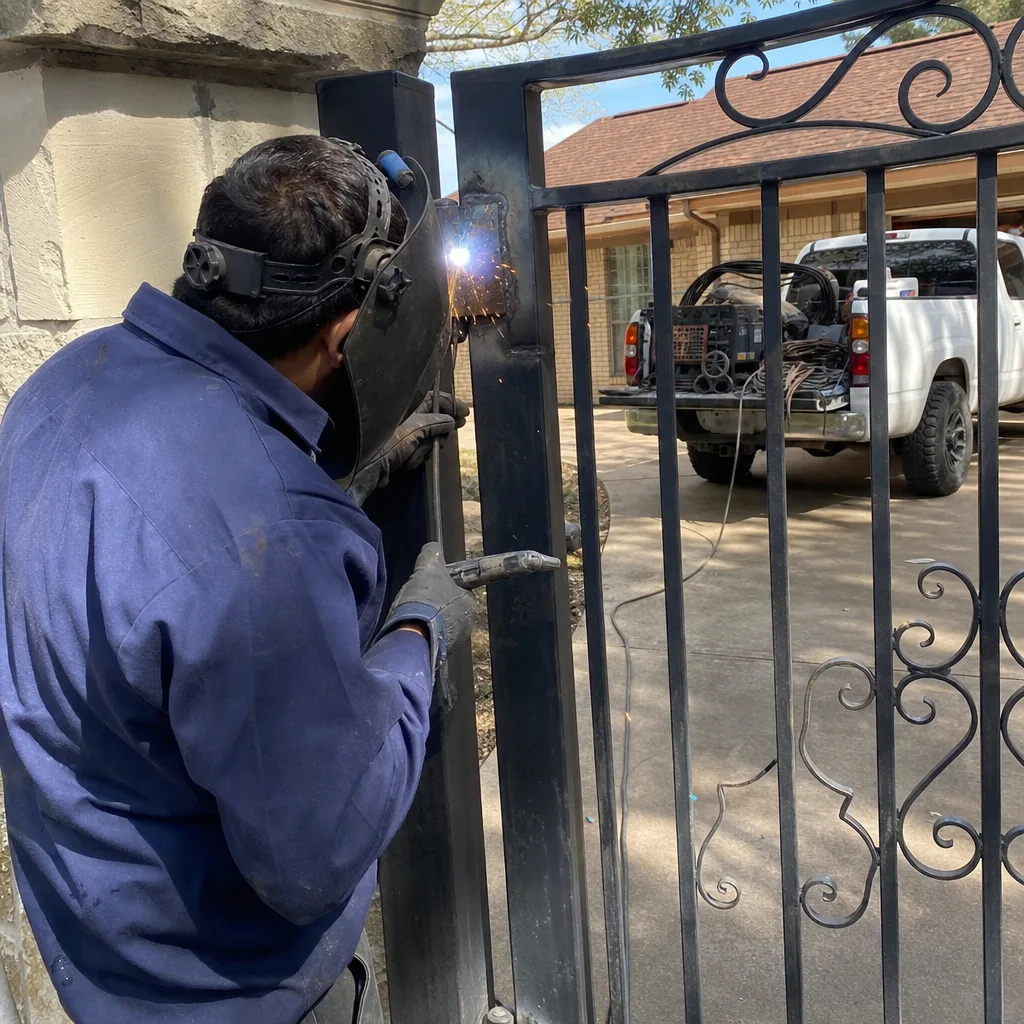
- Why Mesquite Has Two Stress Seasons, Not Four
- What Summer Heat Actually Does to Your Gate
- The Spring Service Window: March-April
- What Freeze-Thaw Cycles Do to Post Footings
- The Fall Service Window: October-November
- The 12-Month Gate Log in One Page
- What to Check Monthly, Regardless of Season
- Common Mistakes to Avoid
- When to Call a Professional
- Frequently Asked Questions
- The Bottom Line
BeforeAfterWhy Mesquite Has Two Stress Seasons, Not Four
Mesquite’s climate is not mild. It is a thermal pendulum that swings from sustained 100°F-plus days in July and August to overnight freezes in January and February, with brief transitional periods in between. If you look at a year of service calls, the pattern is unmistakable: operator failures spike in late summer, and structural problems surface after first freeze. Spring and fall are not really “seasons” here in the traditional sense. They are windows, and they are short. In our experience fixing gates across Mesquite, the homeowners who treat March-April and October-November as mandatory service periods are the ones who go years without an emergency repair. The ones who wait until the gate stops working are the ones paying for new circuit boards in August and new post footings in January.
Here’s the core fact this entire guide rests on: your gate is a mechanical and electrical system under constant environmental load. Heat degrades electronics and lubricants. Freeze-thaw cycles degrade concrete and metal alignment. When you service the gate before each stress season, you’re not doing “maintenance” in some abstract sense. You’re removing the specific points of failure that the coming weather will attack. That’s the whole game.
For anyone in Mesquite who wants a deeper look at how these seasonal stresses translate into specific failure modes, our Gate Repair in Mesquite page covers the common symptoms and what they mean.
What Summer Heat Actually Does to Your Gate
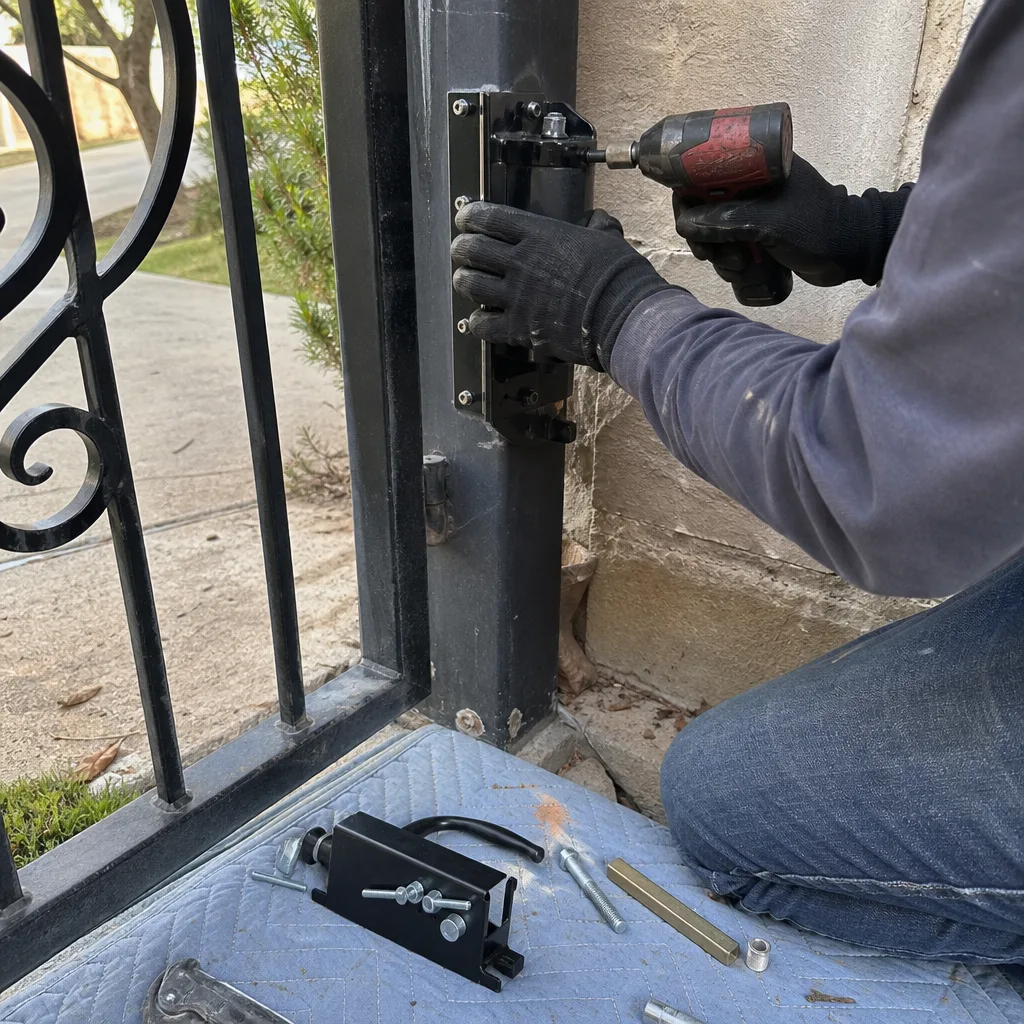
Sustained temperatures above 100°F do three specific things to a gate system, and none of them are visible from the outside until something fails.
First, the grease turns to soup. Inside the operator’s drive train and on the hinge bearings, the grease that was thick and protective at 70°F becomes thin and runny at 105°F. It migrates downward, leaving the upper bearing surfaces dry. Metal runs on metal. You won’t hear it from the house because the gate still cycles, but the wear is happening on every open and close. By the time you hear a dry squeal, the bearing race is scored and the fix is a replacement, not a re-grease. This is the single most common heat-related issue we see on gates throughout Mesquite, especially on older Elite and Mighty Mule swing operators that were originally lubricated with a general-purpose grease never intended for Texas summer temperatures.
Second, the control board cooks. Every gate operator has a control board with capacitors and relays rated for a specific operating temperature range. Most residential boards are rated for ambient operation up to 140°F. That sounds like a lot of headroom, but inside a metal housing mounted on a brick column in direct August sun, the internal temperature regularly exceeds the ambient air temperature by 30°F or more. Sustained internal heat accelerates capacitor aging. A board that would have lasted seven years in a milder climate fails in four here. We replace more LiftMaster and FAAC control boards in August than in every other month combined.
Third, the limit switches drift. Heat causes metal components to expand. On a gate that was calibrated in March at 75°F, the same arm bracket in August at 105°F sits in a slightly different position. That tiny shift changes where the operator thinks the fully-open and fully-closed positions are. The result is a gate that slams harder than it should at the end of travel, or one that doesn’t close flush against the stop. A surprising percentage of “my gate won’t close all the way” calls in summer are not a broken component. They’re a limit switch that needs two minutes of recalibration at the current operating temperature.
The pre-summer service exists to address all three of these before they become failures. That’s the March-April window.
The Spring Service Window: March-April
This is the most important service you’ll do all year. Done correctly, it prevents the vast majority of summer gate failures in Mesquite. Here’s exactly what it includes, with time estimates for each task. A homeowner who is comfortable with basic tools can handle all of these except the board inspection, which requires opening the operator housing and is better left to someone who offers Gate Repair services regularly.
- Re-grease all hinge points and drive components (20 minutes). Remove old, heat-thinned grease and replace it with a high-temperature automotive-grade lithium grease rated to 300°F. Do not use general-purpose grease. Do not use WD-40 as a lubricant. The goal is stable viscosity from 20°F to 110°F. We use a synthetic lithium complex grease on every swing gate and slide gate we service in Mesquite for exactly this reason.
- Check and adjust limit switches (15 minutes). Run the gate through a full cycle and watch the stopping positions at both ends. If the gate slams, bounces, or stops short, the limit switch is drifting. On LiftMaster and FAAC operators, the adjustment is a small dial or screw on the board. Mark the current position with a sharpie before adjusting so you can return to baseline if needed.
- Inspect all wiring connections inside the operator housing (10 minutes). Heat cycles cause terminal screws to loosen over time. A loose neutral wire on a hot August day causes intermittent operation that is maddening to diagnose. Tighten each terminal, photograph the board, and write down the board revision number in your gate log.
- Test the photo-eye alignment and obstacle reversal (10 minutes). The photo-eye is the infrared beam near the bottom of the gate opening. If it’s misaligned by even two inches, the gate will refuse to close, or worse, the safety reversal won’t trigger when a child or pet crosses the path. Place an object in the gate’s path and verify the gate reverses. This is a safety check, not a convenience check.
- Verify the battery backup holds a charge (5 minutes, if equipped). Most newer operators have a 12V battery backup that keeps the gate functioning during a power outage. Heat accelerates battery aging. If the battery is more than three years old and the test shows a weak charge, replace it in March, not in August when it’s backordered and it’s 106°F outside.
Total time investment: about an hour. If you want to hand this off, expect to pay between $125 and $225 for a pre-summer inspection and service call in Mesquite, depending on the operator brand and how much adjustment is needed. Every job we do includes a written price before we start and a documented photo log of every adjustment when we leave. For more detail on what, a full spring service covers, our Gate Motor & Opener in Mesquite page breaks down the components and costs.
What Freeze-Thaw Cycles Do to Post Footings
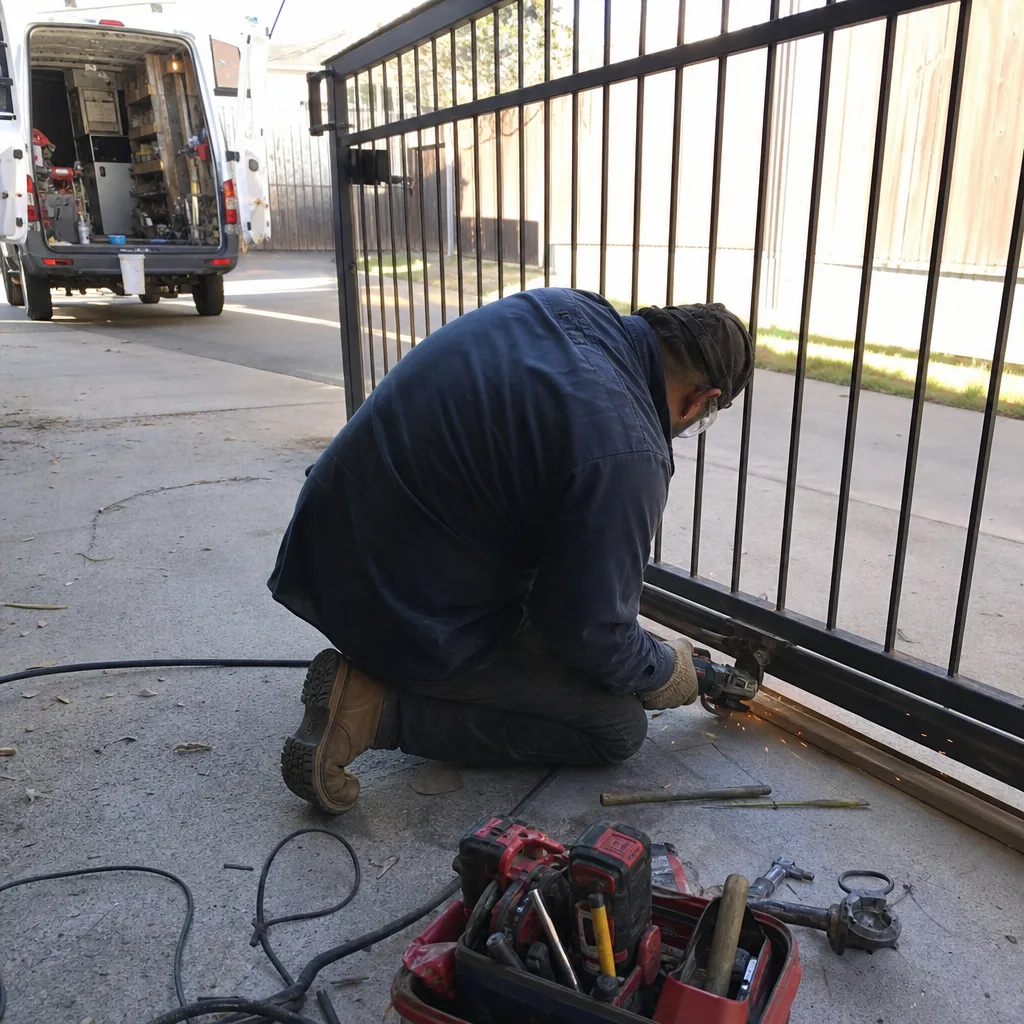
The single most expensive structural failure on a Mesquite gate is not the gate itself. It’s the post footing. And it almost always announces itself in January.
Here’s how it works. Concrete is porous. Over years of exposure, microscopic cracks develop in the concrete footing that anchors each gate post. During a hard freeze, any moisture that has seeped into those cracks expands by roughly 9% as it turns to ice. That expansion widens the cracks. When temperatures rise again, the ice melts, the water drains deeper, and the cycle repeats. Each freeze-thaw cycle does a little more damage. After enough cycles, the footing develops visible surface cracking, and the post begins to lean. Once the post leans far enough to change the gate’s travel path, the operator starts fighting the geometry. Stripped gears, burned motors, and snapped hinge welds all follow.
What does the surface crack pattern look like before the post becomes structurally unsafe? Look for radial cracks running outward from the base of the post across the top of the concrete footing. Hairline cracks that you can barely see are normal and not necessarily a problem. Cracks you can fit a quarter into are a warning. Cracks you can fit a finger into mean the footing is compromised and the post needs to be reset or reinforced. If you see a crack that’s wide enough to hold standing water, water is getting in, and the next freeze will do measurable damage. The fix in that situation is not caulk. It’s removing the old footing, resetting the post, and pouring new concrete with a proper crown so water drains away from the base. In Mesquite’s soil, which is a mix of clay and sandy loam that expands and contracts significantly with moisture content, proper drainage away from the post is the difference between a footing that lasts twenty years and one that fails in five.
Gate Installation in Mesquite covers how we set posts for new gates, including the drainage and footer depth specifications we use for North Texas soil.
The Fall Service Window: October-November
The fall window is your defense against freeze damage and winter battery failures. The work is different from the spring service, and it’s arguably easier, but it has one critical component that most homeowners skip: the grease spec.
Here’s the problem. If you greased your gate in March with a high-temperature lithium grease, you’re in good shape. But if you did a spring service with a general-purpose grease, or if you skipped it entirely, the grease now in your hinge bearings was chosen for convenience, not for the application. Standard general-purpose grease thickens and gels below 20°F. In January, when Mesquite gets a hard freeze, that gelled grease adds enough resistance to the drive train that the operator’s motor has to work significantly harder on every cycle. On a cold morning, a gate that worked fine all fall suddenly won’t move at all. The homeowner assumes the motor died. In most cases, the motor is fine. The grease is frozen.
The correct specification: use a low-temperature synthetic grease rated for continuous operation down to at least -20°F. We use a synthetic lithium complex that stays stable from -40°F to 300°F. That single spec covers every temperature Mesquite has ever recorded and eliminates seasonal re-greasing as a variable. One grease, applied once a year, year-round.
Beyond the grease, the fall service window includes these tasks:
- Re-grease with the low-temp synthetic spec (20 minutes). Even if you used the right grease in March, a fresh light coat before winter removes the summer heat degradation and gives the bearings clean, stable lubrication for the cold months.
- Inspect the post footings for freeze-ready cracks (15 minutes). Walk around each post and look at the concrete. Note any crack wider than a quarter in your gate log. If you catch a problem in October, you can schedule a repair before the freeze arrives. If you wait until January, you’re dealing with it in the cold with a gate that won’t operate.
- Test the battery backup under load (10 minutes). Cold reduces battery capacity. A battery that tested fine in August may be marginal in February. Simulate a power outage and run the gate through three full cycles on battery alone. If it struggles, replace before winter.
- Check the operator housing seal (10 minutes). The rubber gasket around the control board housing is the only thing keeping January rain and condensation off live electronics. A dried, cracked, or missing gasket means moisture gets in, and moisture plus cold equals a shorted board. If the gasket is shot, replace it. A $15 gasket beats a $400 control board every time.
- Verify the gate edges and safety devices (15 minutes). Run the gate and check that every safety edge, photo-eye, and pressure sensor is functioning. Cold weather sends more wildlife looking for warmth, and a functioning safety system keeps a raccoon or a neighborhood dog from getting hurt.
Total time investment: about 75 minutes. If you hand it off to a pro, a fall pre-freeze service in Mesquite typically runs $150 to $250 depending on the operator and condition of the components.
The 12-Month Gate Log in One Page
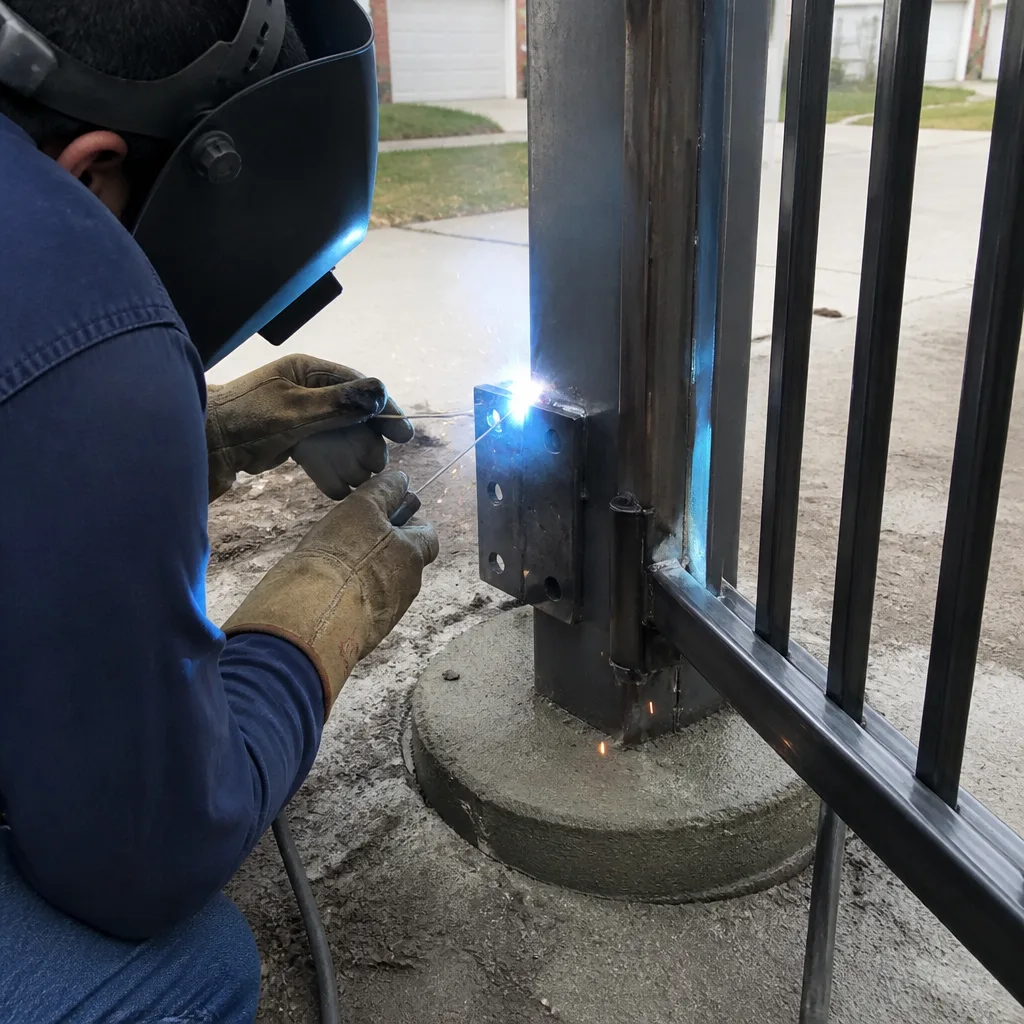
Here’s the single most useful piece of documentation you can create for your gate, and it costs you a notebook and a pen. Build a one-page log that records every service event, every adjustment, and every part replacement across the year. Hand this to any technician who shows up, and you’ve just compressed their diagnostic time from an hour to ten minutes. They won’t have to guess what was done, when it was done, or what brand of grease is sitting in the bearings. They’ll know. In our work across Mesquite, the homes with a gate log are the homes where repairs stay small. The homes without one are the homes where a technician spends an hour discovering that the limit switch was already replaced once in 2022, and the current problem is the same board that was flagged as marginal in 2024.
Here’s what goes on the page. Create one line per service event, with columns for date, technician or person, task performed, parts replaced, readings taken, and notes. A completed line looks like this:
- Date: March 15, 2026
- Person: Self / Vance technician
- Task: Spring service - re-greased hinges with lithium complex, adjusted limit switches, tightened board terminals
- Parts: None
- Readings: Limit switch set to 3.2 seconds open / 3.4 seconds close. Board rev L3. Battery 12.8V under load.
- Notes: Photo-eye aligned. Small crack noted on east post footing, monitored since October 2025, no widening.
That single line tells the next person everything they need in ten seconds. Keep the log taped inside the operator housing door or in a ziplock bag attached to the post. Do not rely on memory. Memory is what makes a $200 repair into a $1,200 re-diagnosis.
We leave a printed photo log and written record on every visit, and if you start your own log, those records drop right into your page so the whole history lives in one place. That’s the same documentation habit Adrian Vance built in commercial access-control work starting in 2014, and it transfers to residential gates without changing a thing. When every job has a written record, no future technician has to guess, and no homeowner pays twice to rediscover the same problem.
What to Check Monthly, Regardless of Season
Between the two service windows, there are a handful of checks that take under ten minutes each month and catch developing problems before they become service calls. Do these on the first Saturday morning of every month, and note anything unusual in your gate log.
- Run the gate through two full open-close cycles. Listen for any change in sound. A new squeal, a grinding noise, or a hesitation at a specific point in the travel is an early warning. Write it down.
- Watch the gate’s stopping positions. If it stops one inch short of fully closed or bounces at the end of travel, the limit switch is drifting. Note the date and adjust at the next service window if it stays consistent.
- Check the photo-eye lenses. Dust and spiderwebs accumulate on the lenses, especially in spring and fall. A dirty lens can trigger false obstruction detection. Wipe with a dry cloth.
- Look at the post footings. You’ll do this thoroughly in October, but a monthly glance catches a crack that forms in July and worsens over the next few months. Trust what you see on the concrete.
- Inspect the operator housing for pests. Mud daubers and ants love the warm, dry space inside an operator housing. A wasp nest in the wrong spot can jam the release mechanism or short a wire. Remove pests carefully and reseal the housing.
Each of these takes a minute or two. The monthly check is habit-building, not a project. It keeps you connected to how the gate normally looks, sounds, and behaves, which makes any deviation obvious. And an obvious deviation caught in June is a $20 fix, not a $500 replacement in August.
If a monthly check turns up something that seems off and you want a second set of eyes, our Vance Gate Repair Mesquite home page lists the services we handle and how to reach us directly at (469) 916-7097. A live person answers at any hour, and a written price is delivered before anyone picks up a tool.
Common Mistakes to Avoid
- Using the wrong grease. General-purpose grease gels below 20°F and thins to liquid above 100°F. In Mesquite, that means you’re under-lubricated in the exact season when you need the grease most. Use a synthetic lithium complex rated for -40°F to 300°F, and you never have to think about it again.
- Skipping the spring service because the gate “works fine.” The failures we see in August started in April. Heat damage is cumulative. The circuit board that dies on a 106°F Tuesday afternoon was slowly degrading for four months. The spring service removes the conditions that accelerate that decay.
- Caulking concrete cracks instead of fixing the drainage. Caulk seals the surface and traps water inside the crack. That water freezes, expands, and makes the crack worse from the inside. The real fix is drainage away from the post, not sealing the surface.
- Ignoring a slightly out-of-alignment photo-eye. A gate that occasionally refuses to close is not a minor nuisance. It’s a safety system in a degraded state. The same misalignment that stops the gate from closing can also prevent the gate from reversing when someone is in the path. Alignment is a safety issue.
- Not keeping a gate log. Every neglected gate has a history. The technician who shows up without that history burns billable time rediscovering what the homeowner already knew. A one-page log eliminates that waste.
- Waiting until after the freeze to check post footings. The damage the freeze does is done before you see the crack. October is the month to look at the concrete. January is the month to pay for what October would have caught.
- Replacing a motor when the grease is frozen. When the gate won’t move on a cold January morning, the motor is usually fine. The grease has turned to wax inside the drive train. Before you authorize a motor replacement, verify the grease spec. A $20 re-grease with the correct product beats a $600 motor that wasn’t the problem.
When to Call a Professional
Some gate work is safe and reasonable for a homeowner. Re-greasing hinges, cleaning photo-eyes, and logging service dates are straightforward. But when the job involves the operator’s control board, the limit switches, high-tension springs, or structural issues with post footings, the right call is a professional. Control boards carry live voltage. Gate springs and torque arms carry stored mechanical energy. A post footing that’s shifting means the entire gate’s weight is not where it should be, and the failure mode is unpredictable. If you’re unsure about the condition of any component, or if a monthly check surfaces something you’ve not seen before, get a written assessment before attempting to fix it yourself. See our DIY vs Professional Gate Repair: The Mesquite Homeowner’s Decision Guide to help decide. Vance Gate Repair Mesquite offers free estimates in Mesquite, and every job comes with a written price before work starts and a photographically documented record when the technician leaves. Call (469) 916-7097, and a live person will pick up.
Frequently Asked Questions

A spring service or fall pre-freeze service in Mesquite typically runs $125 to $250, depending on the operator brand, the condition of the components, and whether the job includes a battery replacement or limit-switch adjustment. The exact price is written and handed to you before any work starts, not after. Call (469) 916-7097 for a free estimate on your specific gate.
Twice a year. Once in March or April before the summer heat arrives, and once in October or November before the first hard freeze. Between those two service windows, a monthly ten-minute inspection keeps you ahead of developing problems. This cadence matches the failure patterns we see across Mesquite, where operator failures cluster in August and structural problems surface in January.
Yes. A live person answers the phone at (469) 916-7097 around the clock, and emergency gate repair calls in Mesquite are dispatched as quickly as a technician can get to you. When you call, you’ll get a written price before the repair starts so there’s no surprise invoice at the end.
A synthetic lithium complex grease rated for continuous operation from -40°F to 300°F. That single product handles Mesquite’s summer heat without thinning and the winter freezes without gelling. Avoid general-purpose grease entirely, and do not substitute liquid spray lubricants for grease on bearing surfaces.
The grease in the drive train has gelled in the cold. Standard general-purpose grease thickens below 20°F to the point where the motor can’t overcome the resistance. The fix is replacement with a low-temperature synthetic grease, not a new motor. We see this exact pattern every winter in Mesquite, most often on gates that were greased with whatever was on hand rather than the correct spec.
Yes. Gate Repair in Mesquite covers LiftMaster, FAAC, BFT, Linear, Viking, Ghost Controls, DoorKing, Elite, and Mighty Mule operators. We repair the operator already on your property rather than steering you toward a replacement unless the existing board or motor is genuinely beyond serviceable life. The work is documented with photos and a written record regardless of brand. For questions about a specific motor, call (469) 916-7097.
The Bottom Line
Your gate in Mesquite fails in predictable ways and on a predictable calendar. Summer heat kills electronics and lubrication. Winter freezes kill post footings and cold-start performance. Both failures are preventable with two service windows: March-April for heat preparation, and October-November for freeze preparation. Add a monthly ten-minute check and a one-page gate log, and you’ve taken a system that most homeowners neglect until it breaks and turned it into a documented, maintained, predictable piece of equipment. When the gate does need work beyond the routine, get a written price before any tool comes out, and a photographic record after the work is done. That’s how we operate at Vance Gate Repair Mesquite, and it’s the standard every Mesquite homeowner should expect from any gate company. Browse more guides & resources for year-round gate care. Call (469) 916-7097 for a free estimate.
Written by Adrian Vance, Owner at Vance Gate Repair Mesquite, serving Mesquite since 2014.