
Last updated September 20, 2026
Free on-site gate assessment - hinges, posts, and your LiftMaster or Nice gate operator checked before anything is quoted
The assessment is free and the quote is the invoice.




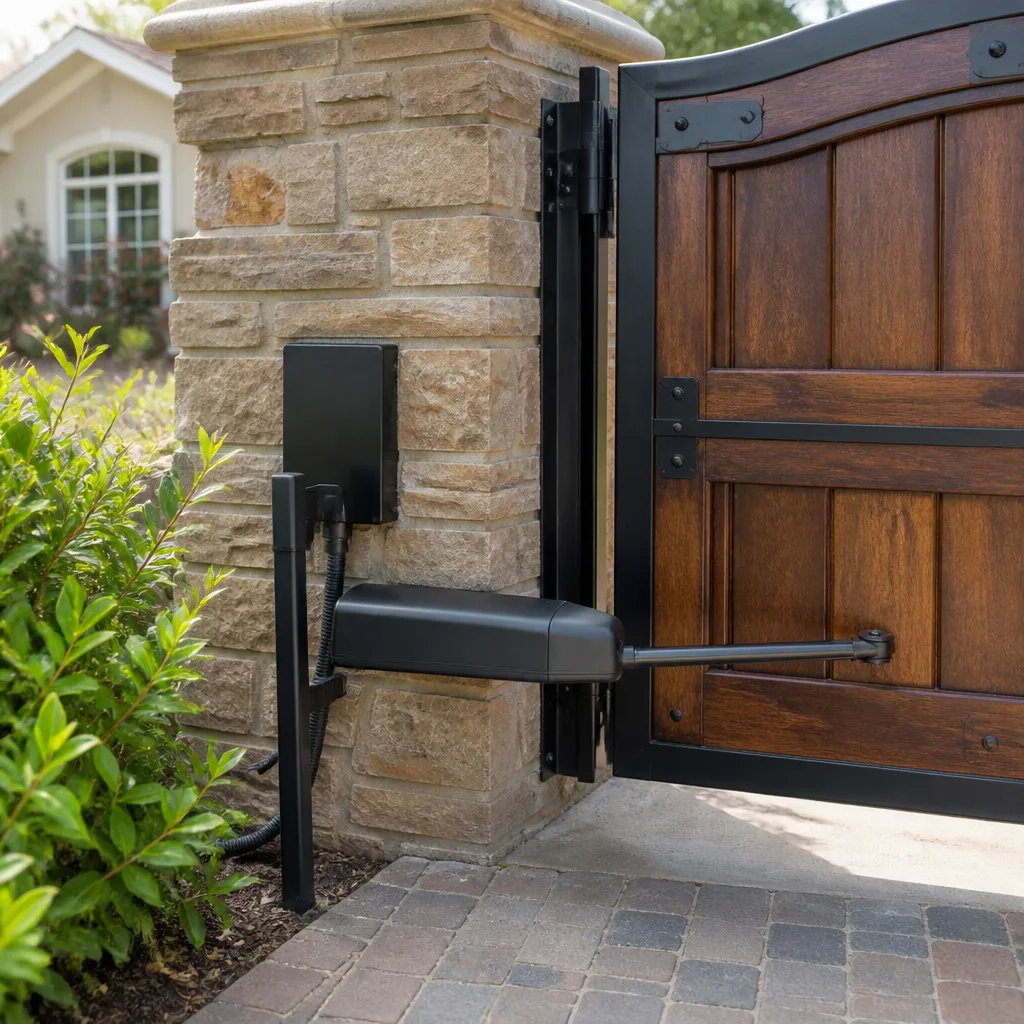
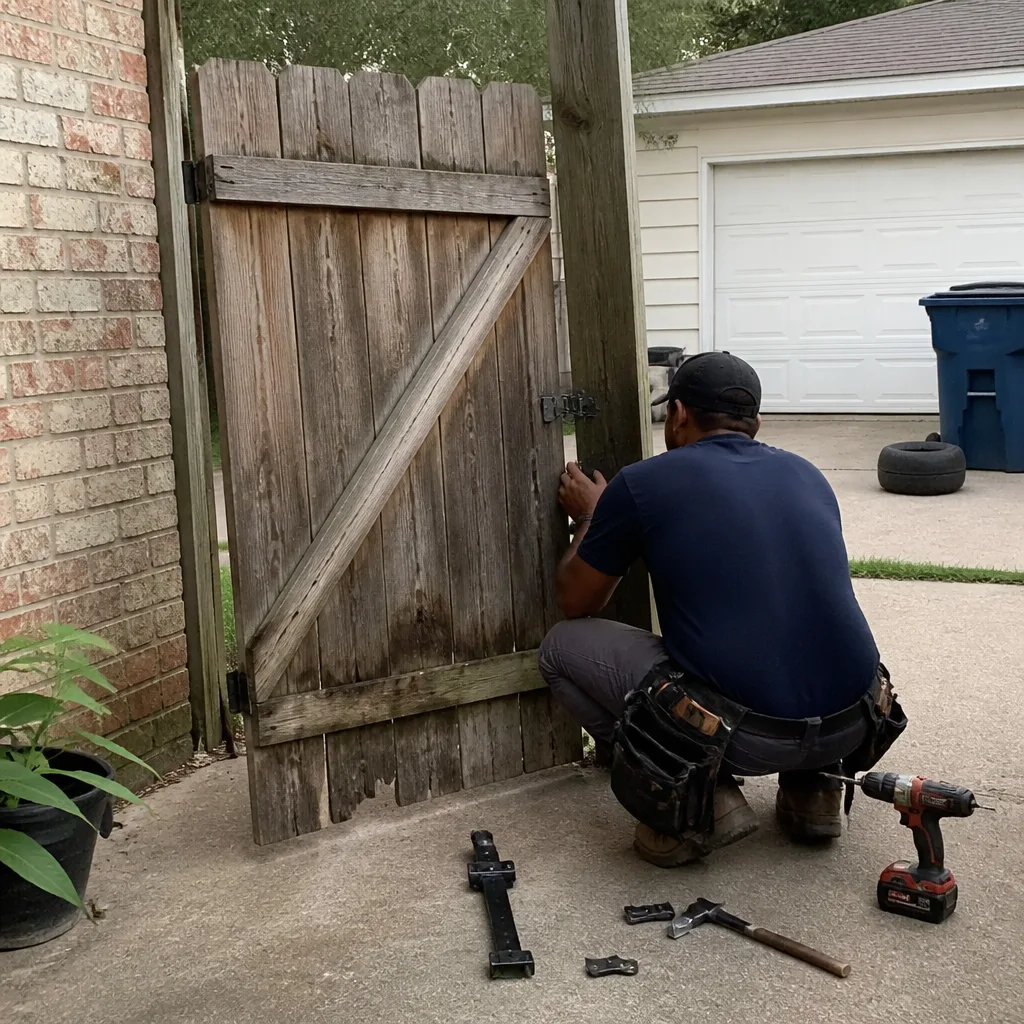 Before
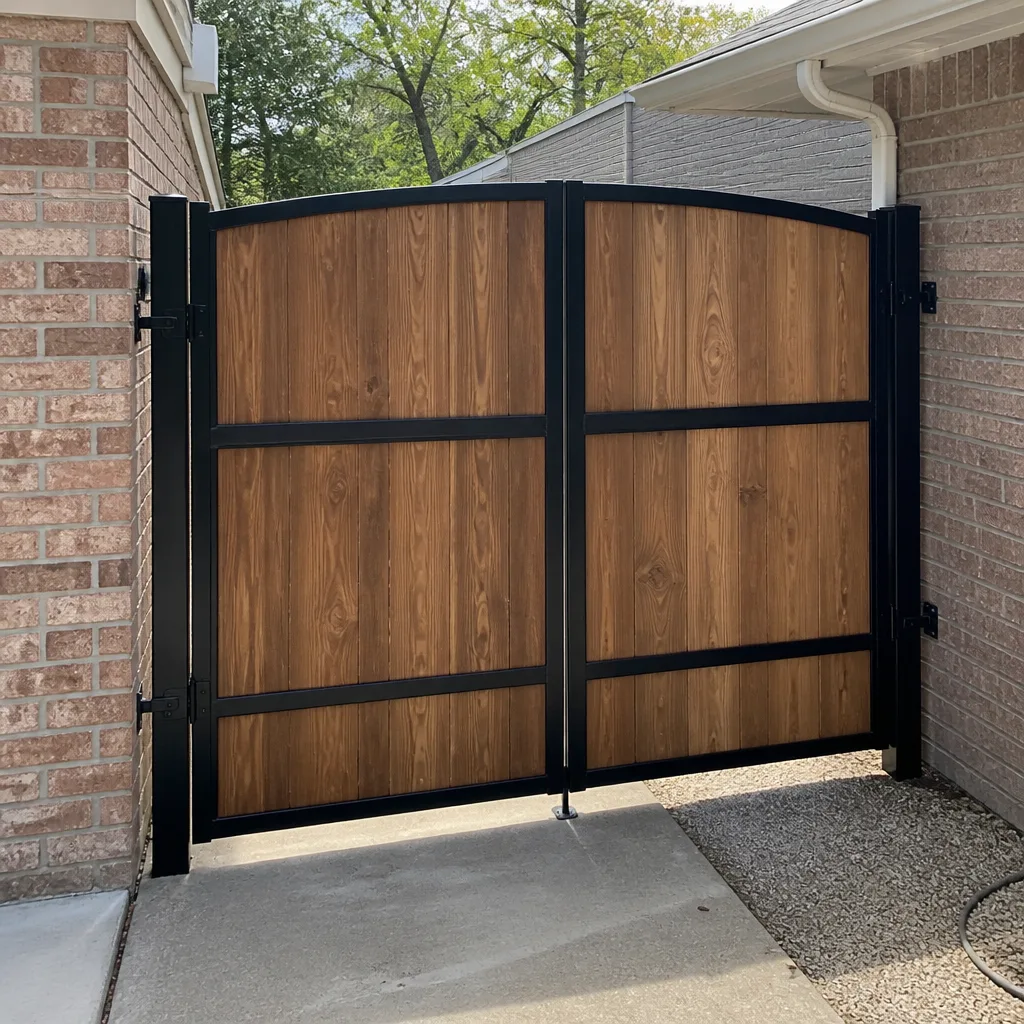 After
After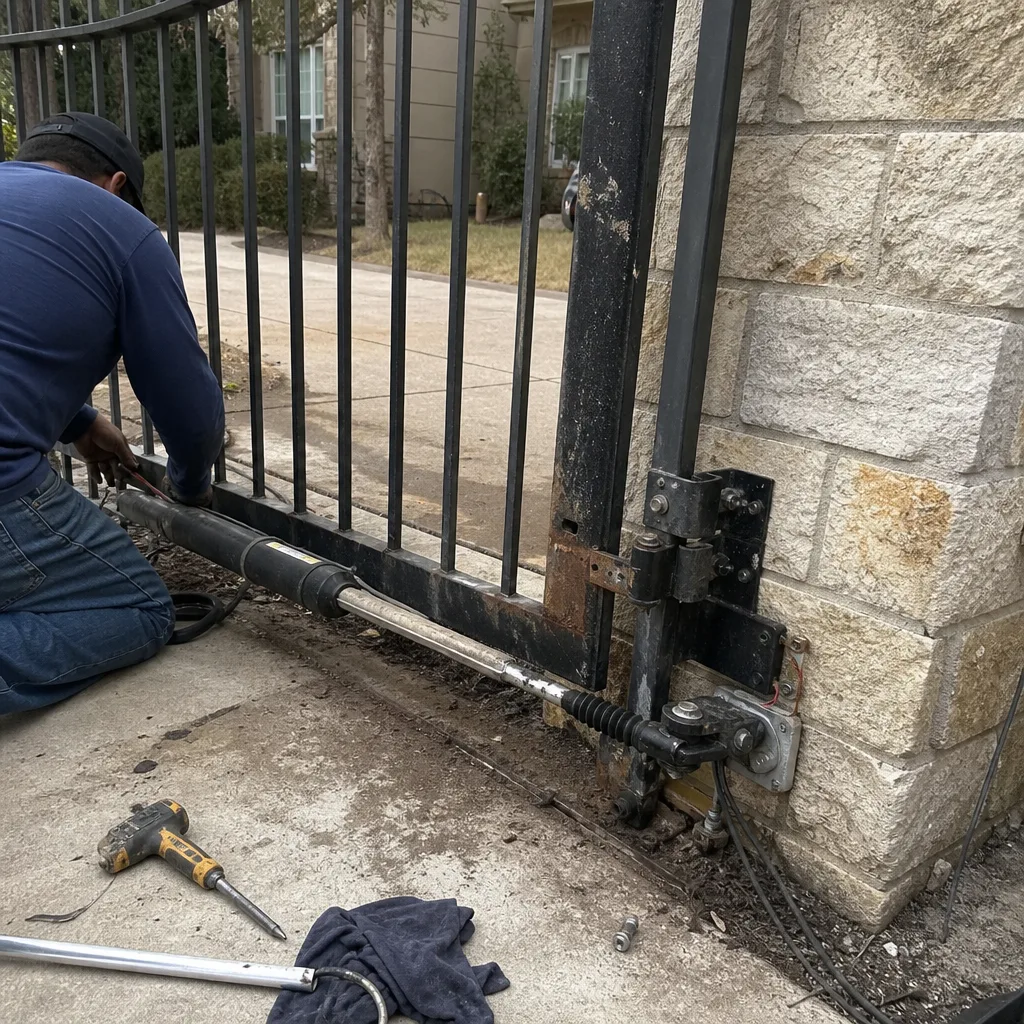 Before
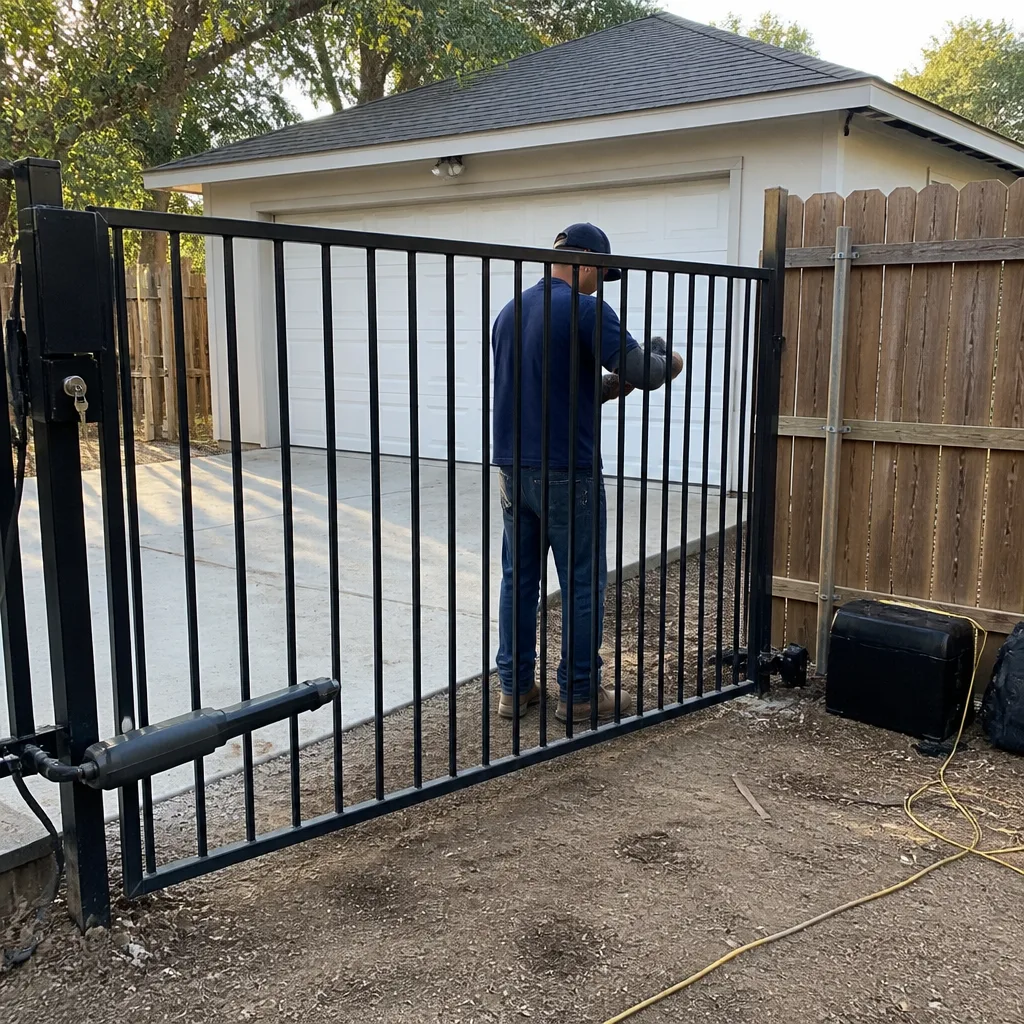 After
After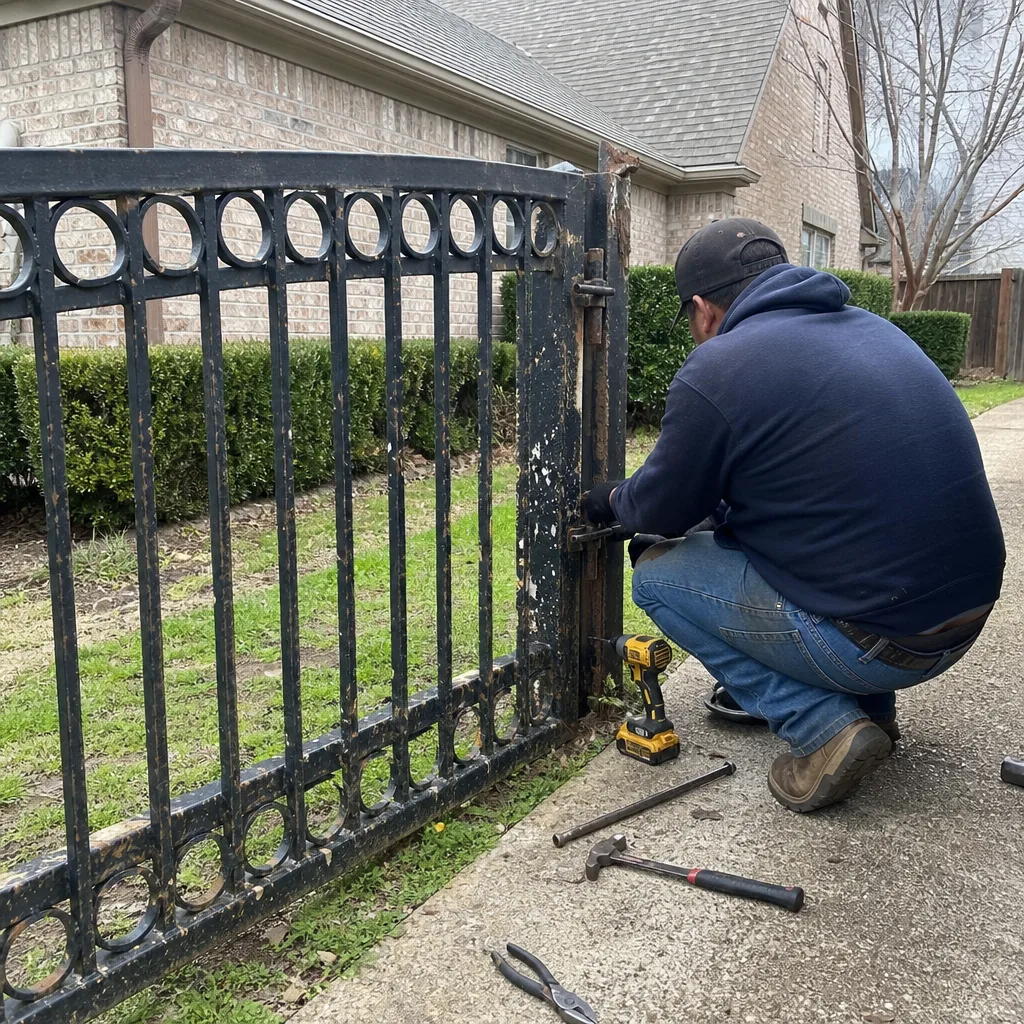 Before
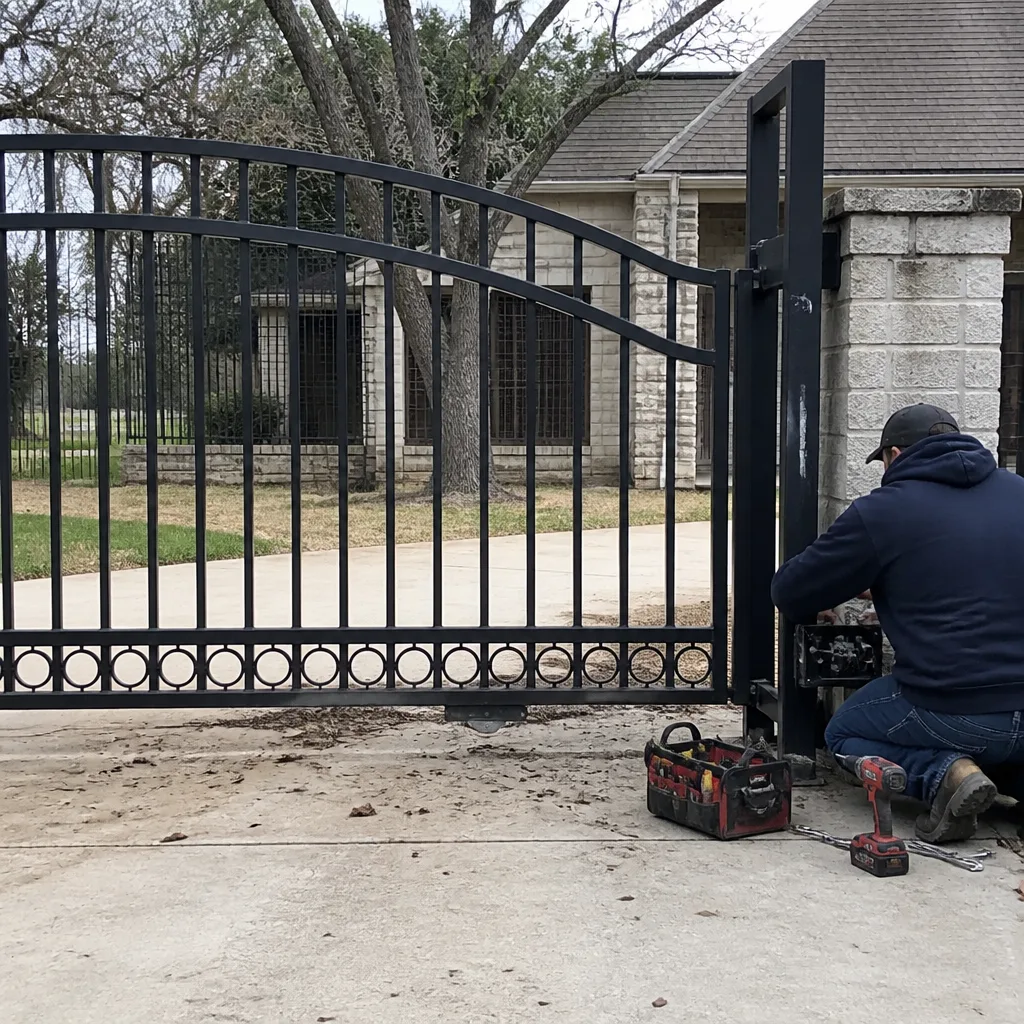 After
AfterGate Repair Maintenance Checklist for Mesquite Homeowners
Most gate maintenance checklists found online read like they were written by someone who has never knelt next to a Mesquite driveway in August. They tell you to check the chain tension but never tell you what “too loose” actually measures or what that looseness is quietly destroying inside the operator. A chain with more than three-quarters of an inch of sag is already accelerating wear on the operator gearbox. That gearbox is a four-hundred-dollar part, and the chain that’s killing it is a five-minute adjustment. This guide is built from service records compiled in Mesquite since 2014, and it will teach you how to read your gate the way a technician reads it: as a set of measurements, not a vague feeling that something seems off.
Quick Answer
A useful Mesquite gate maintenance checklist measures specific wear points against pass/fail thresholds, accounting for summer heat above 100°F and winter freezes that change how every moving part behaves. Run through the inspection items below every three months, log your readings, and call (469) 916-7097 when a measurement crosses the threshold listed instead of waiting for a breakdown.
Table of Contents
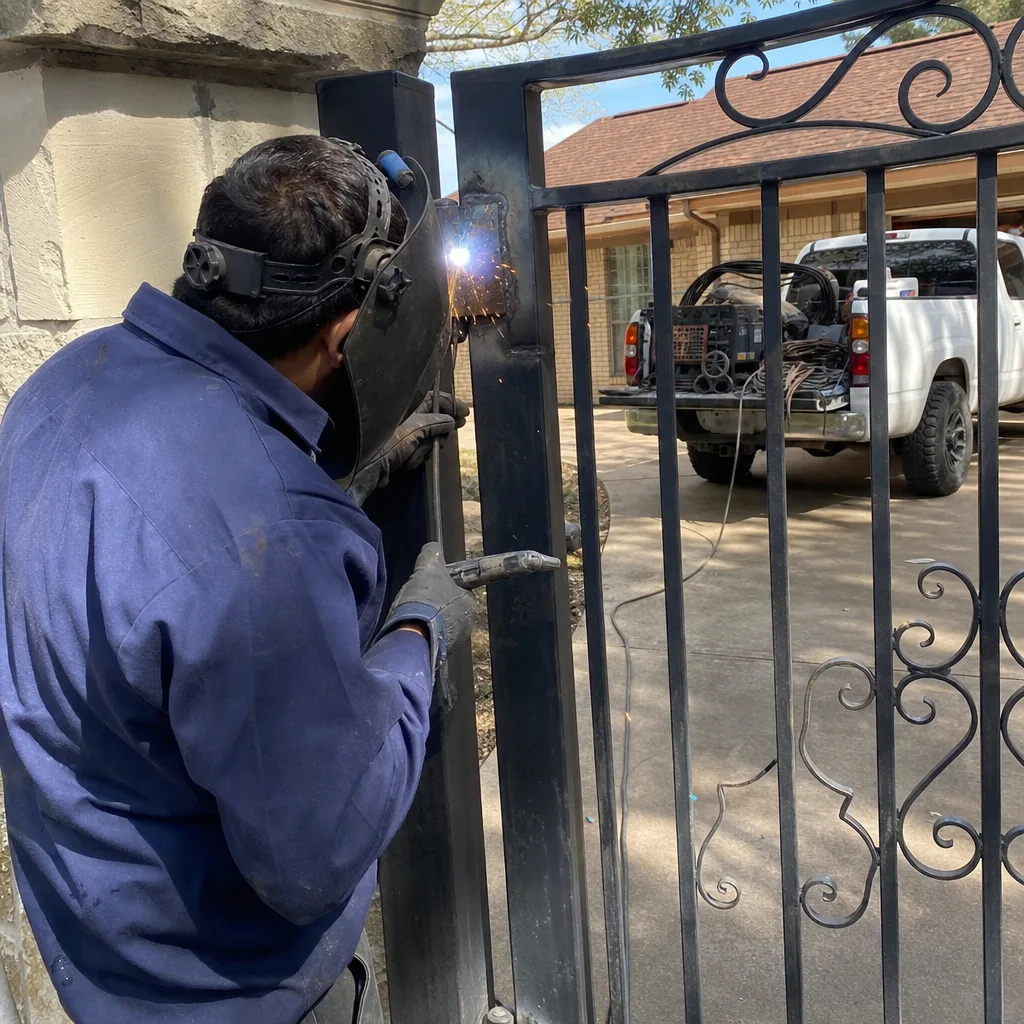
- Chain and Belt Tension: Reading the Sag
- Photocell and Safety Sensor Alignment
- Hinges, Bearings, and Lubrication Points
- Mesquite Climate Stress Points: Heat, Freeze, and Wind
- Electrical and Operator Inspections a Homeowner Can Log
- How to Keep a Maintenance Log That Actually Helps
- The Three Most-Skipped Items That Cause Emergency Calls
- A Seasonal Schedule Built for Mesquite
BeforeAfterChain and Belt Tension: Reading the Sag
Chain tension is the first item on nearly every published gate maintenance checklist, and it’s also the item most homeowners check incorrectly. The question isn’t whether the chain is tight. The question is how much sag is present at the midpoint between the operator sprocket and the gate bracket. On a residential slide gate in Mesquite, an acceptable reading is between one-quarter inch and three-quarters of an inch of measurable play when you press down on the chain with moderate thumb pressure. Under a quarter inch means the chain is over-tensioned, which loads the operator bearings and shortens motor life. Over three-quarters of an inch means the chain is loose enough to skip teeth on the sprocket under load, and every skip sends a shock load through the gearbox.
We’ve pulled operators out of Mesquite driveways where the chain sag measured over an inch and a half. The homeowner had felt the gate shudder and heard a clunk for months. By the time we opened the gearbox, the first-stage gear had visible galling, and the repair was a full operator replacement instead of a tension adjustment. A chain that is tensioned correctly should also be inspected for rust, stiff links, and uneven wear on the sprocket teeth. Stiff links don’t flex around the sprocket and create the same shock-loading condition as a loose chain, even when tension measures correctly.
How to check chain tension
- Disconnect power to the operator using the disconnect switch or breaker. Never reach near a chain that could move under power.
- Press down on the chain midpoint with your thumb. Measure the vertical movement with a ruler.
- Record the reading. Anything under ¼ inch is over-tight. Anything over ¾ inch needs adjustment.
- Check for rust on the chain body and stiff links that don’t straighten when the chain is flexed by hand.
- Look at the sprocket teeth. If the teeth look hooked or the chain sits deeper in some teeth than others, the sprocket and chain may need replacement as a set.
Belt-driven gate operators, common on newer installations, use a reinforced rubber belt rather than a chain. The same sag range applies, but belts should also be inspected for cracking at the tooth roots and glazing on the contact surface. A glazed belt slips silently, and the first sign is often a gate that moves slightly slower in hot weather.
Photocell and Safety Sensor Alignment
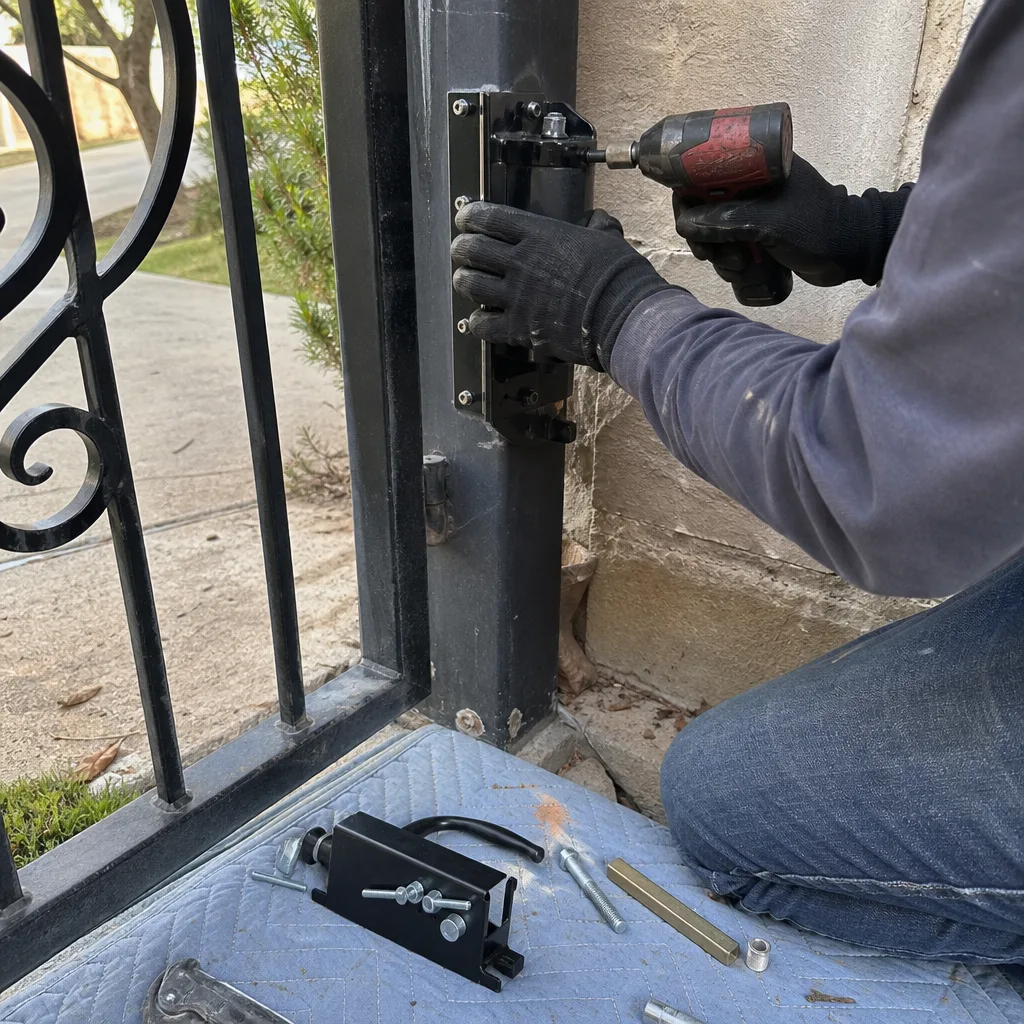
A photo-eye is the infrared beam that stops the gate if something crosses the path while the gate is moving. Safety standards require them on automated gates, and in Mesquite they fail in a very specific way: the sun. Intense direct sunlight can saturate the receiver and cause false obstruction readings, which makes the gate refuse to close or reverse mid-cycle. Houston and Dallas share this problem, but Mesquite’s open, flat residential lots with south-facing gate runs see it more frequently than shaded city lots.
Alignment matters more than most homeowners realize. The transmitter and receiver need to point at each other within a tolerance of a few degrees. You can check alignment visually by looking for the small LED indicator on the receiver. A solid green light typically means the beam is aligned and connecting. A blinking or red light means the beam is broken, misaligned, or the receiver is being blinded by direct sun. We set alignment with a meter, but a homeowner can spot a trend: if the light reads solid in the morning but blinks every afternoon between 2 p.m. and 5 p.m., the problem is likely the sun angle, not the wiring. In that case, a small sun shield on the receiver often solves the issue without replacing any components.
Clean the photo-eye lenses with a dry microfiber cloth during every maintenance pass. Mesquite dust and pollen accumulate quickly, and a film that reduces beam strength by even twenty percent can cause intermittent faults on hot days. The lenses are typically plastic, so avoid glass cleaner with ammonia, which micro-clouds polycarbonate over time.
Hinges, Bearings, and Lubrication Points
Gate hinges on a swing gate carry the entire weight of the gate leaf through a very small contact area. When the hinge pins dry out, the gate gets harder to move, the operator draws more current, and in severe cases the hinge plates can shear. A Mesquite homeowner should hear almost nothing when the gate moves. Squeaking, grinding, or a rhythmic creak at the hinge line is a lubrication issue on the day you hear it and a bearing replacement issue six months later if ignored.
Use a heavy-bodied grease or a moly-fortified lubricant on metal hinge pins. Spray lubricants like WD-40 are solvents first and lubricants second. They quiet a squeak temporarily and then leave the pin dryer than it was before. For a swing gate, put a small amount of grease on the pin at the top of each hinge and work the gate through its full travel a few times to distribute it. Wipe away what squeezes out, because the excess will collect Mesquite dust and become an abrasive paste.
On slide gates, the equivalent points are the guide rollers and the track. Rollers should spin freely when you turn them by hand; a roller that skids instead of rolling is already wearing a flat spot. Tracks should be cleaned of debris regularly. A pebble in the track is enough to make a slide gate stall, and in Mesquite the combination of wind and decomposed granite landscaping means track debris is a near-constant presence. Check the wheels for wobble by pressing sideways on the gate at each roller location. A quarter-inch of lateral play means the roller bearing is worn.
Lubrication checklist
- Grease hinge pins on swing gates every six months with a heavy-bodied grease.
- Oil roller bearings on slide gates with light machine oil every three months.
- Clean the track and remove debris monthly during windy seasons.
- Apply a dry PTFE lubricant to lock mechanisms and key cylinders; avoid liquid oil in locks, which traps grit.
- Check weather seals for compression. A compressed seal has taken a set and lets dust into the operator housing.
Mesquite Climate Stress Points: Heat, Freeze, and Wind
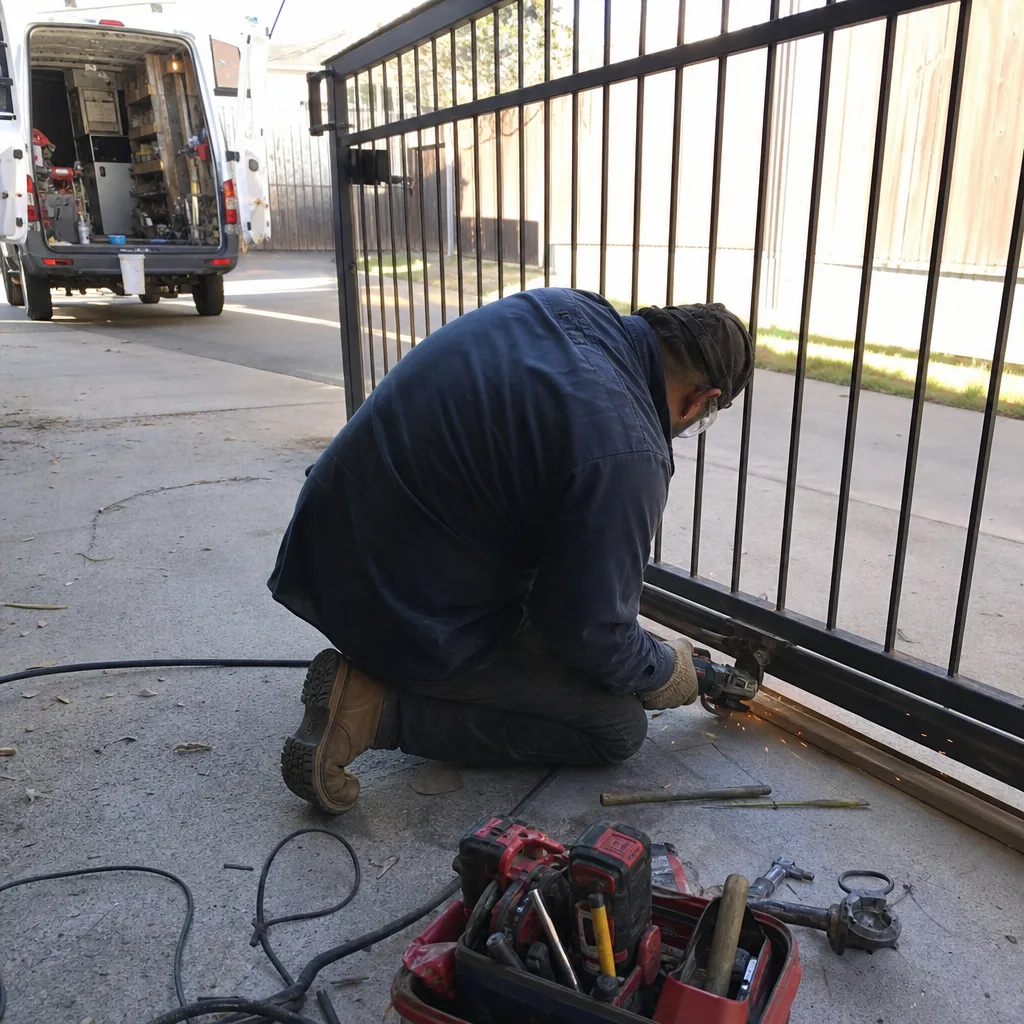
Mesquite’s climate punishes gate hardware in three distinct ways, and each one affects a different component. Summer heat above 100°F loosens tolerances, softens rubber, and increases electrical resistance in every connection between the control board and the motor. Winter freezes thicken lubricants and make the motor work harder. The wind, especially in spring and early summer, drives fine dust into every open bearing and connector.
Heat does two things to photocells as noted above: direct sun saturates the receiver, and the thermal expansion of the mounting bracket can shift alignment over a summer by two or three degrees. If your gate starts refusing to close only on the hottest afternoons, that’s the pattern of sun saturation, not a failing motor. A sun shield is a ten-dollar fix that solves most cases.
Rubber seals and edge strips age faster in Mesquite than in cooler climates. A safety edge that is cracked or stiff won’t compress properly when the gate contacts an obstruction, which means the safety system won’t trigger. This is a code and safety issue, not just a cosmetic one. Press on the edge strip during every check. It should compress and rebound within a second. If it’s hard, cracked, or slow to return, replace it.
Freeze events change how viscous the grease in the operator gearbox becomes. A motor that runs smoothly at 50°F can draw significantly more current at 20°F, and if the gearbox is already worn or the grease is old, that extra current draw can trip the overcurrent protection or stall the gate mid-travel. A homeowner can record whether the gate sounds different on cold mornings. A low growl at the motor during a freeze that disappears when temperatures rise is the sound of cold grease, and it’s a useful data point for a technician.
Electrical and Operator Inspections a Homeowner Can Log
You don’t need a meter to gather useful electrical information from your gate operator. The LEDs on the control board, the behavior of the remote, and the sound of the motor all produce data you can record in a maintenance log. What you should not do is open the operator cover and start adjusting potentiometers or limit switches unless you know what the limit switch controls and what a wrong setting does. A limit switch that is set too late lets the gate travel too far and load the mechanical stops, which bends brackets and strips gears. That’s a torque-spec adjustment, not a homeowner adjustment.
Operator items a homeowner can check safely
- Listen to the motor on every cycle. A smooth, consistent hum is normal. A rhythmic pulsing or a change in pitch through the travel suggests mechanical load that isn’t constant.
- Watch the gate speed. A gate that has slowed by more than twenty percent since new has a drag problem somewhere, usually a hinge, a roller, or an under-lubricated gearbox.
- Check the control board for visible corrosion or ant colonization. Mesquite’s clay soil holds moisture against operator posts, and ants are attracted to the warmth of control boards. Either condition can cause intermittent faults that look mysterious and are painful to diagnose remotely.
- Cycle the gate three times in a row on a cool morning and three times in a row on a hot afternoon. If it fails only in the heat, the issue is thermal, which narrows the problem to a specific set of components.
- Check that the manual release disengages smoothly. A manual release that requires force to pull is a mechanical issue in the release linkage, not the motor.
If the gate trips a breaker or blows a fuse, don’t reset it repeatedly. A breaker that trips more than once in a month is reading an overcurrent condition, and the gate is telling you something specific. Repeated resets compound the damage. This is the point to call a professional. Vance Gate Repair Mesquite services gate motors and openers across Mesquite, and on service calls like these we document the current draw on the motor so the homeowner sees the number, not just the repair.
How to Keep a Maintenance Log That Actually Helps
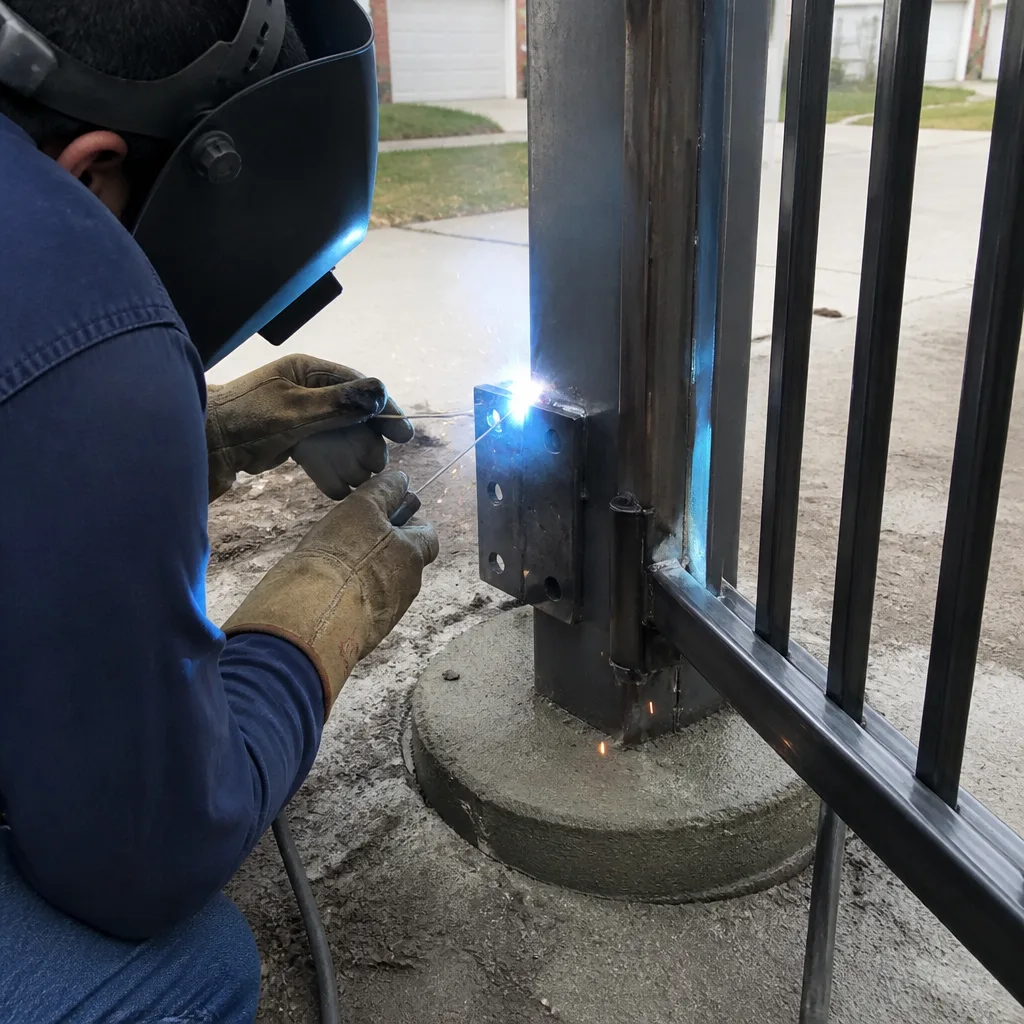
A maintenance log has one job: it should let a technician spot a trend in three minutes. Most homeowners don’t keep one, and the ones who do keep it in a format that doesn’t help. A notebook page that says “gate seemed slow in March” is less useful than a line that reads “cycle time 22 seconds at 70°F, March 4.” The first is a feeling. The second is a measurement.
The log should record four things on every check: the date, the outside temperature at the time of the check, the full-open to full-close cycle time in seconds, and any change in sound, speed, or behavior since the last check. That’s it. Four fields. If you take the extra step of recording chain sag or hinge play as a number, even better, but those four fields alone will let a technician see whether a slowdown is gradual or sudden, thermal or constant.
Gradual slowdown over six months suggests mechanical wear. A sudden slowdown that starts after a storm or a freeze suggests a single event, like a bearing that got wet and rusted or a gearbox that lost grease. A slowdown that only appears above 95°F suggests an electrical or thermal component. Without the log, every visit starts from zero and the technician has to guess what “normal” means for your gate.
When we arrive at a gate with a year of logged cycle times, the diagnosis is faster and the repair is smaller. This is the same principle behind the documentation we leave after every job at Vance Gate Repair Mesquite home: when the next technician shows up, the record says what was found, what was set, and what was installed. No one pays twice to rediscover the same problem.
The Three Most-Skipped Items That Cause Emergency Calls
In our service records, three maintenance items account for a disproportionate share of emergency calls in Mesquite. All three are cheap to check and expensive to ignore.
1. The chain sag described above
This is the number one skipped item because the chain looks fine at a glance. A chain with three-quarters of an inch of sag is already wearing the operator gearbox. By the time the homeowner notices shuddering, the gearbox has usually been damaged. A full operator replacement for a residential slide gate in Mesquite typically runs between $600 and $1,100 depending on the brand. The chain adjustment that prevents it is a maintenance item.
2. The photo-eye sun saturation pattern
Homeowners reset the operator or assume the remote battery is dying because the gate refuses to close only on hot afternoons. The actual cause is often the receiver being blind to the beam during the hours when the sun hits the lens directly. A sun shield costs very little. Ignoring it leads to repeated false obstructions, which eventually causes the homeowner to disable the safety function, which is a serious safety violation. Don’t bypass the photo-eye. Shield it.
3. Hinge and roller wear on swing gates
Swing gate hinges that get loud are the most ignored problem because the gate still works. It’s noisy, but it moves. Over time, the hinge pins wear, the gate sags, and the leaf drops enough that the latch misses the strike. Then the operator bends its own bracket trying to close a gate that can’t latch. By the time we see it, the hinge job has become a weld repair plus a new latch plus a possible operator bracket replacement. A six-month hinge greasing and a yearly play check prevents most of this.
A Seasonal Schedule Built for Mesquite
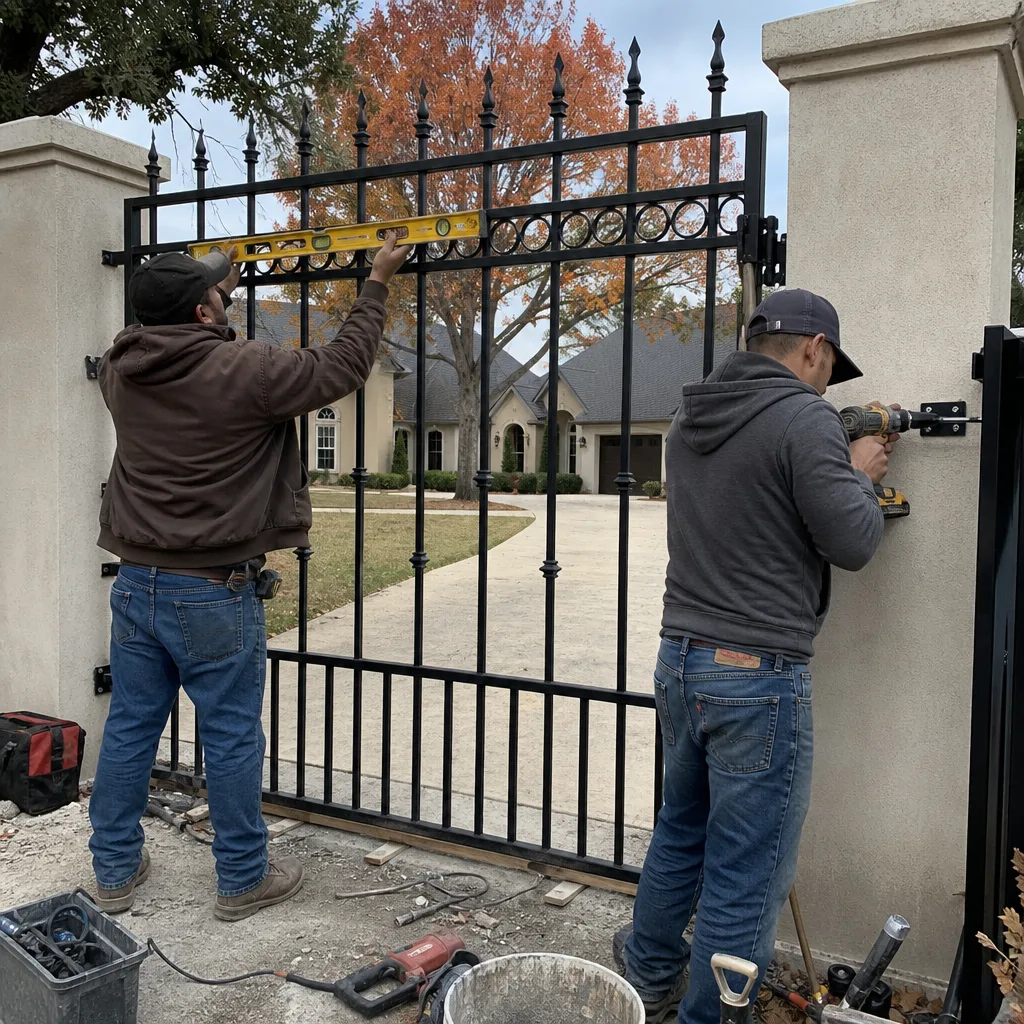
Maintenance intervals from national gate guides don’t always fit Mesquite. A checklist written for a mild coastal climate underestimates dust, heat, and the thermal cycles that loosen hardware. Here’s the schedule we recommend for residential gates in Mesquite, based on the patterns we see in service calls.
Spring: Pre-summer inspection
- Complete the full checklist: chain sag, photo-eye alignment, hinge or roller play, track debris, seal condition.
- Grease all hinge pins and lubricate rollers before the heat arrives.
- Check that the photo-eye receiver is not in direct afternoon sun; install a shield if it is.
- Run the gate through ten full cycles and log the cycle time at a consistent temperature.
Summer: Heat watch
- Log cycle times on a day above 100°F and compare against spring numbers. A heat-only slowdown is a diagnostic clue.
- Check the operator housing for dust accumulation and clear any buildup around vent holes.
- Listen for a change in motor pitch through the afternoons.
- Check that the gate does not bind at the mechanical stops when the metal has expanded. A gate that clunks hard at the stop in August is traveling too far for current temperatures.
Fall: Post-summer wear check
- Re-measure chain sag and hinge play. The summer heat has done its work on the hardware.
- Inspect the safety edge and all rubber seals for cracking from heat exposure.
- Clean the track thoroughly and check rollers for flat spots.
- Check the control board for ant damage. If ants nested in the housing over summer, the board needs to be inspected by a professional.
Winter: Freeze preparation
- Listen to the motor on a cold morning. Low growl means cold grease; log it.
- Check that the gate still opens smoothly when temperatures are near freezing. If it slows by more than thirty percent, a technician should evaluate the gearbox.
- Confirm that the manual release still operates without excessive force.
- Verify the photo-eye works in low-angle winter sun, which is a different failure mode than summer sun.
Brands like BFT, Linear, and Ghost Controls all have documentation that recommends specific maintenance intervals. We’ve found that the generic guidance from any of those manufacturers under-serves Mesquite’s specific conditions, which is why we recommend the schedule above. It matches the failure patterns we actually see in local service calls, not the failure patterns a national manual assumes.
Common Mistakes to Avoid
- Checking the chain by feel instead of measuring it. “Feels loose” isn’t a reading. Use a ruler or tape measure and record the actual sag. A chain that measures over three-quarters of an inch is loading the gearbox.
- Using a spray lubricant on hinge pins. Spray products flush out old grease and leave the pin dryer than before. Use a heavy-bodied grease on metal-to-metal contact points.
- Ignoring afternoon-only failures. A gate that fails only between 2 p.m. and 5 p.m. in summer is almost always a photo-eye sun issue. Replacing the motor won’t fix it. A sun shield will.
- Resetting a tripped breaker repeatedly. The breaker is doing its job. The overcurrent condition that trips it is the problem. Call a professional before the condition becomes a motor replacement.
- Bypassing the safety edge when it stops working. A disabled safety edge converts a maintenance issue into a liability. The edge is the part that stops the gate from hitting a person. Replace it when cracked or stiff.
- Never opening the operator housing. Homeowners often tell us they avoided the operator for years out of caution, and by the time they call, a small electrical issue has become a mechanical failure. Checking what’s accessible, like control board LEDs, without adjusting anything is safe and useful.
- Paying for a repair without asking for documentation. If the technician can’t tell you what was adjusted, what the reading was, and what part number went in, you’ll pay to rediscover the same problem later. On every gate repair in Mesquite, Vance Gate Repair leaves a photographed record and a written scope. That documentation is the whole point.
When to Call a Professional

Some checklist items require tools, training, or safety precautions a homeowner doesn’t have. Call a professional when the gate has damaged operator gears, an electrical fault that trips a breaker, a safety sensor that can’t be aligned without a meter, or any hinge or roller that shows visible metal deformation. Also call when the gate is making a sound you can’t identify or when a multi-year maintenance log shows a trend you can’t explain. Gate systems involve high-tension components and line voltage; a trained technician knows where the stored energy lives and how to release it safely. Vance Gate Repair Mesquite offers free estimates in Mesquite. Call (469) 916-7097 and a live person answers, day or night.
Frequently Asked Questions
Run the full inspection checklist every three months, with extra checks before summer heat and before winter cold. Mesquite’s dust, heat, and thermal cycling wear parts faster than mild-climate assumptions built into national maintenance guides, so a quarterly pass with a six-month lubrication routine keeps most gates running for years longer. For more guides & resources, check our blog. Call (469) 916-7097 if any measurement crosses the threshold in this guide.
Most residential gate repairs in Mesquite run between $180 and $650 depending on the problem, with operator replacements commonly landing between $600 and $1,100. A chain tension adjustment is a small service charge; a gearbox replacement is the expensive result of ignoring the chain. Every job from Vance Gate Repair Mesquite includes a written price before any work starts, so the number on the invoice is the number on the quote.
Yes, for the items in this guide that require measurement and visual inspection: chain sag, track debris, seal condition, hinge play, control board corrosion, and cycle-time logging are all homeowner-appropriate. Leave limit-switch adjustments, gearbox work, and any electrical repair to a professional, because those involve torque specs, meter readings, and live components.
A complete gate installation in Mesquite includes the gate frame and infill, hinges or track hardware, the operator and control board, photo-eye safety sensors, safety edge if required, and adjustable limit switches. The installation should end with a documented record of the settings. If the installer can’t tell you what the limit switch was set to or what the cycle time was on day one, you have no baseline for future maintenance.
Yes. Vance Gate Repair Mesquite runs low-voltage and line-voltage wiring, installs photo-eyes and safety edges, and documents the position and settings of every sensor before leaving. The safety system is not optional on an automated gate, and the photo-eye alignment needs a meter to set correctly, not just a visual check.
We service nine major automation brands including BFT, Linear, Viking, and Ghost Controls, which means the motor already on your property can usually be repaired rather than replaced. We don’t steer customers toward a replacement when a repair is the right call. Call (469) 916-7097 with your operator brand and a live person answers.
The Bottom Line
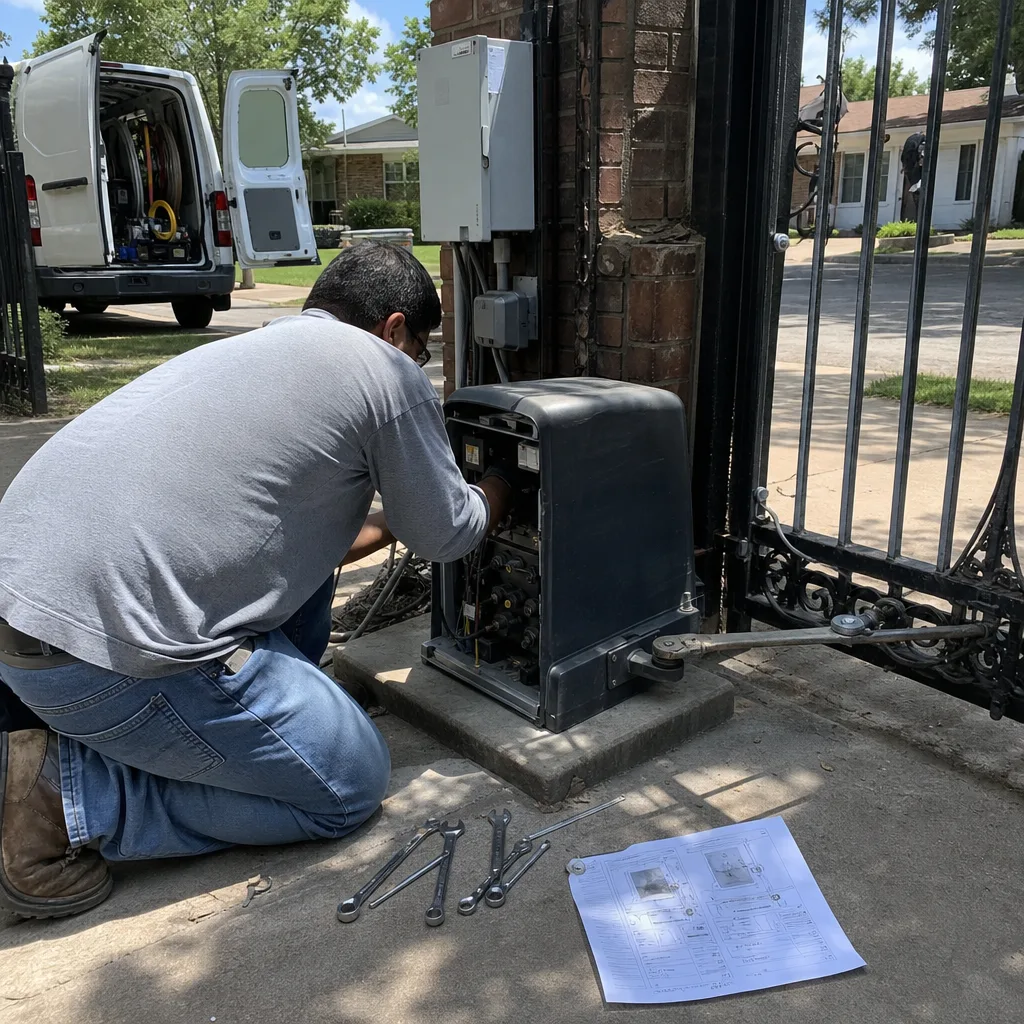
A gate maintenance checklist only earns its space on your refrigerator if it tells you what a reading means. Chain sag over three-quarters of an inch is a gearbox failure waiting to happen. A photo-eye that fails only in afternoon sun is a shield problem, not a motor problem. A hinge that squeaks is a bearing on a timer. Measure, log, and act on thresholds, and your Mesquite gate will outlast the national averages. When a measurement crosses the line or the trend doesn’t make sense, call (469) 916-7097 or check out Gate Repair Warning Signs: A Mesquite Homeowner’s Reference Guide for a free estimate with a written price before any work begins.
Written by Adrian Vance, Owner at Vance Gate Repair Mesquite, serving Mesquite since 2014.